
 中文
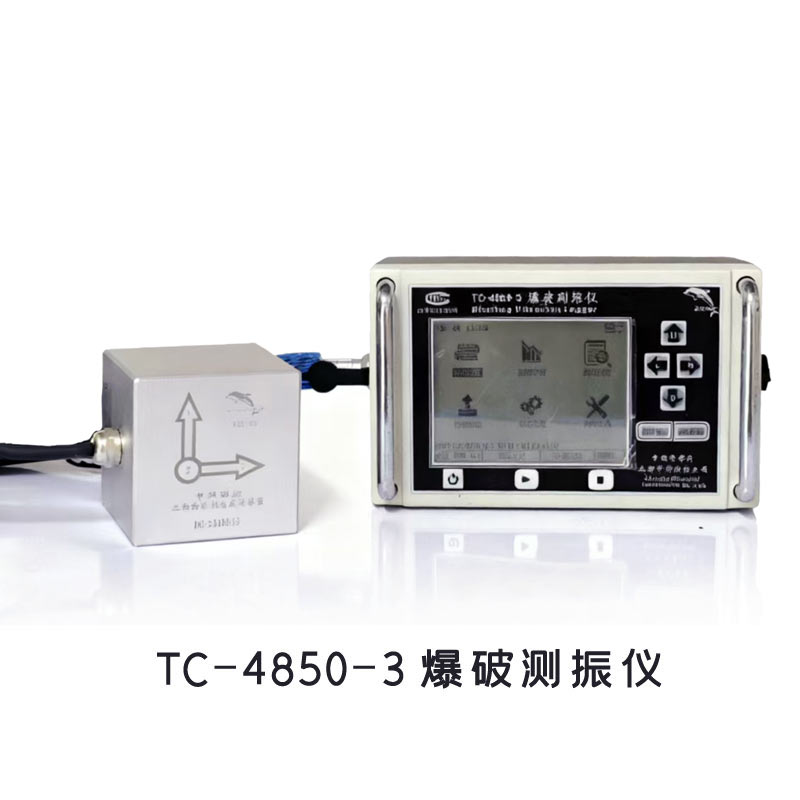
New-Generation TC-4850-3/6 Blasting Vibr 4
For blastingThe new-generation TC-4850 blasting vibration meter developed by ZKCK offers optional 3/6 channels and measures the vibration velocity and frequency at the monitored point induced by blasting and other artificial earthquakes. It can be used for blasting vibration monitoring and environmental safety assessment of dams, bridges, tunnels, railways and highways, various vibration monitoring in similar fields, and as experimental teaching equipment for related university majors.
Channels
3/6-channel parallel acquisi…
Sampling rate
up to 100 K Sps, multi-step …
Range
self-adaptive; 0-35 cm/s wit…
Resolution
0.0001 cm/s
Key Specifications
Parameters below are extracted from this page; values and units are kept verbatim.
The TC-4850 is a multifunctional monitor designed for engineering blasting. Compact, portable, pressure/impact resistant and easy to operate, with proper sensors it measures acceleration, velocity, noise sound pressure,air (underwater) pressure,displacement, temperature and other dynamic processes - monitoring, recording, alarming and analysis. With a built-in display and keypad, users can complete setup and data reading on site without a computer.
A new-generation intelligent blasting vibration meter, fully upgraded from the classic TC-4850, with stronger functions and improved specifications. It supports 6-channel parallel acquisition and can connect two triaxial sensors simultaneously, each outputting both vibration velocity and acceleration - simplifying tests, improving efficiency and saving cost.

▲ Acquisition parameters
Channels: 3/6-channel parallel acquisition, cascadable (TC-4850-3: 3 channels,TC-4850-6: 6 channels))
Sampling rate: up to 100 K Sps, multi-step adjustable
Range: self-adaptive; 0-35 cm/s with standard sensor
Resolution: 0.0001 cm/s
Reading accuracy: 0.1 %
A / D :24 Bit
Clock accuracy: ≤5 s/month
▲ Recording parameters
Trigger mode: manual, single, continuous, external trigger, synchronized trigger
Trigger level: 0-10 V freely adjustable (0-35 cm/s with standard sensor)
Data output: simultaneous velocity and acceleration output
Record duration: 1-5590 s, freely adjustable
Delay: custom negative delay supported
Data overwrite: auto-overwrite supported
Storage: up to 1.8 million records (equivalent to 1 T - fast and stable)
▲ Physical parameters
Dimensions: main unit 185 mm × 120 mm × 75 mm; standard sensor 66×66×66 mm / 45×45×45 mm
Weight: main unit 1.8 kg; standard sensor 0.687 kg
Display: 3.7-inch LCD, Chinese/English, characteristic values and waveforms;
Power: 5-12 V wide-range supply; built-in battery works 3 days continuously; external battery extends runtime beyond one month;
Keypad: 9 touch keys,
Ports: all-aviation-connector I/O
Environment: -30 to 75 ℃, 90 % RH, IP64 splash-proof
▲ Data access
Connect to PC for data download
On-site batch download via USB drive
Upload to cloud platform via software for data access
On-site direct printout (requires a POS printer))
▲ Data analysis
Frequency spectrum, power spectrum
First-order calculus, high/low-pass filtering, noise sound pressure analysis
2/3-vector composition,segment analysis
Sadovsky empirical formula for K and α (velocity prediction, charge estimation)
Multi-window waveform display with data comparison
▲ Event reports
Blasting vibration safety assessment per GB6722-2014 etc.
Safe-distance calculation for protected structures, safe charge calculation
Batch export with characteristic-value filtering
Batch export of multiple data sets to Word/WPS/PDF reports
Export raw data in txt/dat/csv for secondary analysis
▲ Other functions
Scheduled power on/off
Local/client zero calibration
USB-drive system upgrade and client-side upgrade/maintenance
One-click clock sync with client
Data alarms, low-battery and low-disk alarms
▲ Sensor selection
Standard configuration:
TC-4850-3 with one TCS-3 triaxial sensor; TC-4850-6 with two TCS-3 triaxial sensors; Frequency range: 5-500 Hz; range 35 cm/s; for routine vibration monitoring
Low-frequency velocity:Optional 1-500 Hz triaxial velocity sensor for low-frequency signals, e.g. 1-10 Hz low-frequency vibration from medium-deep hole and chamber blasting, soft soil and underwater blasting
High sensitivity:Optional high-sensitivity triaxial velocity sensor for micro-vibration signals
Acceleration:Optional uniaxial/triaxial acceleration sensors for acceleration monitoring; ranges selectable
Shock wave:Optional air/underwater shock-wave sensors for blast-induced overpressure monitoring; ranges selectable
Noise sound pressure:Optional noise sensor for sound pressure monitoring, covering steady, transient and impulse noise.

PreviousNoneNextNew-Generation TC-4850N-3/6 Network Vibration Meter
