
 中文
Industry Solution · Tunneling
Tunnel Excavation Blasting Vibration Monitoring Solution
PPV control at portals & full-cycle vibration records

With every advance blast, rock ahead, lining behind, an operating tunnel possibly overhead and villages right outside the portal. Even with perfect ground support, a weak link in vibration control can still cause trouble. ZKCK provides tunneling with a three-track solution: face tracking + existing-tunnel special monitoring + long-term online."
Pain PointsPAIN POINTS
Close-spaced tunnels, under-crossing existing lines and parallel old tunnels: blasting vibration directly threatens operation safety and linings. Railway authorities impose strict requirements on point layout and data reporting.
Portals are often next to villages and plants — compensation for one shattered window costs far more than monitoring.
Long-duration monitoring is needed — the portable "run between points" mode cannot keep up.
Weak 4G inside tunnels — data must have "multiple escape routes".
Reference StandardsSTANDARDS
Safe allowable PPV criteria (transport tunnel & housing classes)
Items and frequency of railway tunnel monitoring
Highway tunnel construction monitoring requirements
Key ChallengesCHALLENGES
Low vibration frequency (medium-deep hole blasts have significant low-frequency content) — low frequencies contribute heavily to structural damage, so instrument frequency response must cover them.
Existing tunnels are operating structures: installation must be fast and secure, outside the clearance envelope, without affecting traffic or maintenance.
Blasting overlaps with mucking and shotcreting — points must stay fixed long-term and resist flyrock and machine impact.
Data must map to each blast in the advance, forming a "one blast, one file" record.
Existing-tunnel special: how to deploy & install
Deployment rules (graded by distance S from blast to protected object)DEPLOYMENT
| Distance class | Point layout & testing requirements |
|---|---|
| S ≤ 100 m | Place 3 points on the side near the blast: 1 in the cross-section of the blast center, 1 each 20 m ahead and behind along the tunnel; protected objects measured on every blast; 85% of the allowable value as the alarm level |
| 100 m < S ≤ 300 m | Use regression of measured data to derive the maximum charge per delay; subsequent per-delay and total charges must not exceed the tested safe limit |
| 300 m < S ≤ 1000 m | At least one initial test with 3 points arranged as above; protected objects measured at least once initially; later charges controlled by the safe limit |
Installation essentials (field-proven standard workflow)INSTALLATION
Fix the sensor to the sidewall with the special bracket: mark drilling positions → drill → anchor with expansion bolts (or fix directly with a powder-actuated nailer — twice the efficiency); level the sensor on the bracket and tighten.
Put the host in the protective box and connect signal cables per the cable-slot direction; insert the SIM card — the boot screen showing "normal communication" confirms correct installation; press Record and tap the sensor to verify acquisition.
Three power options for long-term monitoring: 40 Ah Li-battery (≈30 days); solar panel (at open ground near the portal, survives 10 consecutive overcast days); external power via cable (cable fixed to the tunnel wall, waterproof joints).
No network inside the tunnel: extend the signal by wired/wireless relay, or lay optical fiber to a covered area for internet access — fully automated monitoring.
Face & long-term online schemes
Recommended combination: TC-4850-3 (face tracking) + 6850 (existing-tunnel points) + TC-4850N-3/6 (portal long-term online)
| Model | Role | Key capabilities |
|---|---|---|
| TC-4850-3 | Near-field monitoring advancing with the face | 24-bit, self-adaptive range with no setup, built-in display for on-site reading; accepts low-frequency velocity sensor (1–500 Hz optional) for low-frequency vibration; 5–300 Hz frequency response |
| 6850 | First choice for existing-tunnel points | Integrated, only 560 g, fastest to install; 0.01–1000 Hz; simultaneous velocity (0–50 cm/s) and acceleration (±16 g); local ≈1 TB + unlimited cloud; 4G full-network + cloud platform |
| TC-4850N-3/6 | Long-term online at portals / key sections | 3/6 channels, local ≈1 TB + unlimited cloud, up to 1.8 million events; 4G + Wi-Fi + LAN + RS-485 multi-channel backhaul; 4-route free alarms (SMS + WeChat + client + API) |
ParametersPARAMETERS
Synchronize multiple TC-4850N units for a common time axis across points in the same sectionMulti-unit synchronized triggering — velocity-attenuation comparison made easy; Sadovsky regression computes K and α automatically to back-calculate the safe charge for the next blast.
With an accelerometer attached, the TC-4850Naccelerometer outputs velocity and acceleration simultaneously — velocity for safety judgment, acceleration for structural response.
Remote scheduled power on/off follows the tunneling rhythm automatically — unattended, no missed blasts.
Cloud platform + mini-program report download: supervisors, owners and railway authorities read data on their phones — reporting requirements met.
Why ZKCKWHY ZKCK
3-class distance deployment rules + standard installation workflow + matching brackets — guidance ready to implement.
Integrated, no wiring; fixed quickly inside the tunnel within the working window of an operating line.
Optional 1–500 Hz low-frequency velocity sensor dedicated to the low-frequency band of medium-deep hole blasts.
4G / Wi-Fi / LAN / RS-485 + relay & optical fiber — points networked without obstacles.
Data feeds design and acceptance filing directly; "one blast, one file" generated automatically.
Dig fast, but blast steady — every blast on record.

Network architecture: synchronized multi-unit acquisition managed on ZKCK Cloud, extensible by relay / optical fiber
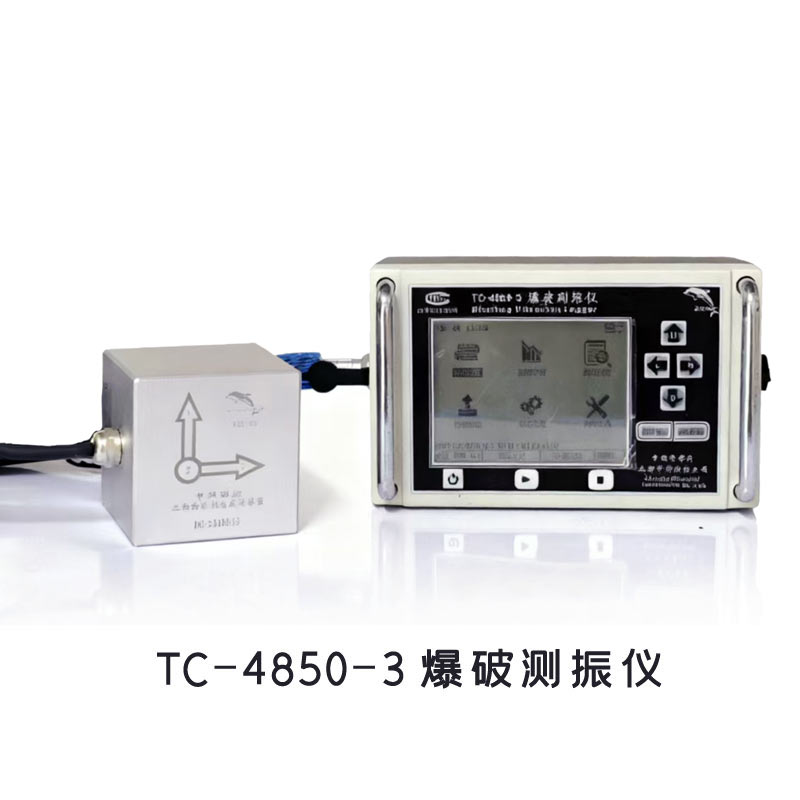 TC-4850 Blasting Vibration MeterPortable · Self-adaptive range · Fast deploymentView details →
 TC-4850N Network Vibration Meter3/6 channels · Solar + battery · Long-term onlineView details →
 6850 Integrated Network VibrometerVelocity + acceleration · Only 560g · OLED displayView details →
More Solutions
- Section: Solutions
- Platform: ZKCK Cloud (Online Monitoring)
