
 中文
Bridge Health & Safety Vibration Mon 4
Bridge VibrationZKCK develops high-precision bridge vibration instruments for vibration monitoring of large dams and bridges. With a built-in 4G (all-netcom) module and WiFi, data can be uploaded to the cloud server over the Internet wherever mobile or WiFi signal is available. Users can view data in real time, receive alarm messages and remotely control the instrument from anywhere.
1) All-in-one mode
sensor + acquisition + trans…
2) Split mode
external sensor + separate a…
Key Specifications
Parameters below are extracted from this page; values and units are kept verbatim.
▲ Overview
China's infrastructure is advancing rapidly, boosted by the Belt and Road Initiative - there are now more than 700,000 bridges with main spans over 30 m.
To ensure the operational safety of important and large bridges, and in accordance with the transport industry standard JT/T1037-2016 "Technical Specification for Structural Safety Monitoring System of Highway Bridges" and our vibration-technology development plan, we have launched a series of monitoring devices for the structural safety of operating bridges. They suit bridge vibration monitoring caused by wind, vehicles, earthquakes, blasting, construction and vessel impact, providing wireless measurement of acceleration, velocity and frequency of bridge structures or components. Main monitoring items:
1. Bridge loads and environment (vehicle loads, vessel impact, wind speed, direction, pressure, temperature & humidity, earthquakes, etc.).
2. Overall structural response (lateral/vertical main girder, triaxial vibration acceleration at the arch crown, etc.)
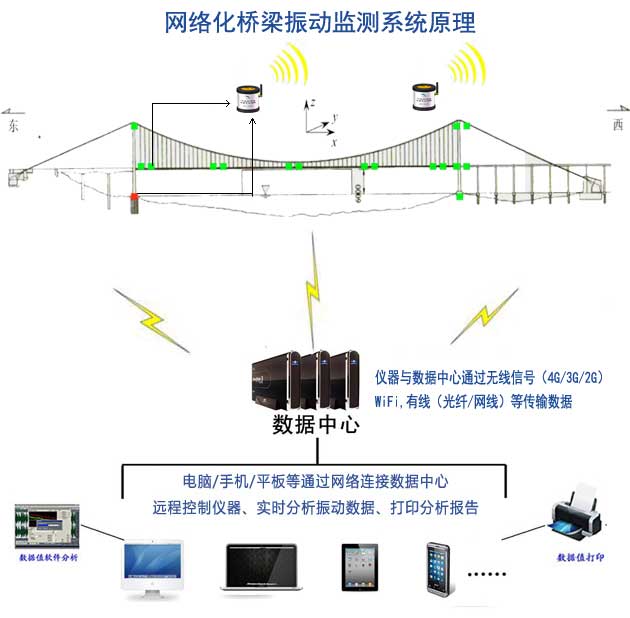
▲ System composition
Two system modes:
1) All-in-one mode: sensor + acquisition + transmission integrated (>> e.g. the 6850 integrated vibration meter)
2) Split mode: external sensor + separate acquisition/transmission (>> e.g. micro-vibration sensor + 4850N vibration meter)
▲ Advantages
· Inheriting 30 years of technical resources from the Chengdu Scientific Instrument R&D Center of the Chinese Academy of Sciences, we carefully build portable vibration meters with current international advanced level.
· The product has passed Microsoft's rigorous compatibility testing - 100% compatible and stable with Windows - and earned the Microsoft WHQL hardware quality certificate.
· Holds the national measuring instrument production license (CMC certificate); test results are legally valid for metrological transfer and testing.
▲ Installation and analysis
1. Instrument installation
1) Fix the bridge micro-vibration acceleration sensor (screws or bonding) at vibration-sensitive locations (the measuring points) - usually on both sides of the center of each span on the deck, or on both sides of the bridge (pier tops), arch crown, tower top, etc.
2) For the TC4850NQ (acquisition/transmission unit), fix it near the measuring point with proper shelter (from rain, snow, wind and dust), connect it to the sensor with the dedicated signal cable, and set a vibration trigger threshold according to the test environment, object and purpose (to prevent interference causing false triggers and recording useless micro-vibration data).
3) For the 6850 vibration meter, fix the instrument directly at the measuring point and set a vibration trigger threshold according to the test environment, object and purpose (to prevent interference causing false triggers and recording useless micro-vibration data).
2. Data transmission
The system transmits data to the host computer or data service platform via mobile signal or WiFi. Testers can monitor bridge vibration data remotely for a long time (24/7/365).
3. Data processing and analysis
The host computer or data platform finally obtains the vibration acceleration data uploaded by each point as vibration curves with time on the horizontal axis and acceleration on the vertical. Thousands of such curves can be measured; through Fourier transform (FFT) or half-wave dominant-frequency processing, amplitude-frequency characteristic curves are obtained (frequency on the horizontal axis, acceleration amplitude on the vertical).
Note:
We are also developing modal parameter identification software for natural frequency, mode shape and damping coefficient of bridge structures, helping bridge inspection users judge structural changes, damage or anomalies from shifts in natural frequency, for a scientific safety assessment of the bridge.
Verification certificate - China National Institute of Measurement and Testing Technology

