
 中文
Industry Solution · Open-pit Mining
Open-pit Mine Blasting Vibration Monitoring Solution
From single-shot monitoring to unattended online networks — data that stands up in court

Every blast at a quarry or open-pit mine can affect nearby houses, slopes and high-voltage facilities. Neighbor disputes, compensation claims and slope instability are not caused by a lack of experience — what is missing is vibration data that stands up to legal scrutiny. Building on 30 years of instrument heritage from the CAS Chengdu Institute of Instruments, Zhongke (www.zkck.com) provides open-pit mines with a complete solution from single-shot measurement to unattended online monitoring.
Pain PointsPAIN POINTS
Blasting vibration is the No.1 source of complaints from villagers around mines. Without data, "everyone tells their own story"; with data, disputes can be settled.
High steep slopes may develop cracks and accumulate damage under repeated blasting, requiring long-term, continuous, multi-point vibration observation.
Under GB 6722-2014 Blasting Safety Regulation, blasting must control particle vibration velocity and keep monitoring records on file.
Most mining projects now require integration with the mine-safety supervision platform: direct data reporting and threshold-linked alarms. Standalone "island systems" fail regulatory acceptance.
Mine monitoring points are scattered with poor access; manual data collection is costly and slow.
Reference StandardsSTANDARDS
Safe allowable PPV criteria; basic requirements for vibration monitoring
Slope monitoring and stability evaluation requirements
Safety management of mine blasting operations
Key ChallengesCHALLENGES
Mixed protected objects: houses (adobe / masonry / frame), slopes, heritage and pipelines — each with different allowable velocity, requiring standard-based point-by-point evaluation.
High blast frequency over long periods: production blasting runs for months or even years — portable "carry the instrument around" testing cannot cover it.
Poor communications in mountain areas: intermittent 4G means data backhaul cannot rely on a single channel.
Supervision platforms differ in interface standards and alarm grading (some 4-level, some 2-level) — the system must adapt flexibly.
SolutionsSOLUTION
6850 / 4850N series
4G · WiFi · LAN
Alarm · Reports · Regulator upload
6850
Online monitoring of slopes & remote points
All-in-one design, only 560 g, built-in OLED display, frequency response 0.01–1000 Hz, simultaneous velocity (0–50 cm/s) and acceleration (±16 g) output, local ≈1 TB + unlimited cloud storage
TC-4850N-3/6
Long-term monitoring on houses / facilities
24-bit high precision, 3/6 channels, local ≈1 TB + unlimited cloud, 4G full-network + Wi-Fi + LAN multi-channel backhaul, external battery 30+ days or solar power, cascadable for more points
TC-4850-3
Temporary, single-shot surveys
Portable 1.8 kg, built-in display & keypad for on-site reading, self-adaptive range with no setup, fast deployment and fast wrap-up
Recommended combination: 6850 (integrated online) + TC-4850N-3/6 (network workhorse) + TC-4850-3 (portable supplement)

ZKCK cloud architecture: multi-sensor access, API integration with supervision platforms and client terminals

Field photos: open-pit mine & slope monitoring points — solar powered with wireless backhaul uploading around the clock
Deployment & ParametersDEPLOYMENT
Set points at the nearest house foundations, slope crest/mid-slope and key facility foundations; orient the X-axis of triaxial sensors toward the blast center.
Enable 4G full-network + cloud platform on 6850 / 4850N; threshold exceedance automatically triggers SMS + WeChat official account + client + API multi-level alarms (free of charge, no platform fees).
Connect data to the mine-safety supervision platform via the free API for direct reporting and remote supervision. Alarm grading supports two modes: 2-level alarm and 4-level alarm (e.g. blue/yellow/orange/red, cascading into reminder, alarm, reporting and work-stoppage/evacuation). Switch flexibly per local regulatory requirements — non-compliant systems fail acceptance, so confirm this before purchase.
Make full use of the 4850N's sensor flexibility: one host accepts velocity, acceleration, air shock-wave and noise sensors — one deployment covers multiple physical quantities.
Event reports are generated automatically after every blast; monthly statistics/trend reports export for a complete filing evidence chain.
Why ZKCKWHY ZKCK
CPA pattern-approval certificate — monitoring data can serve as the basis for dispute resolution and regulatory filing.
Free API connects directly to supervision platforms, supporting both 2-level and 4-level alarm modes to match regional requirements — no interface or platform fees.
Free cloud platform + free API + free alarms — no hidden costs for long-term online monitoring.
One 4850N host with different sensors measures velocity, acceleration, shock-wave and noise — protecting your investment.
Solar + external battery keeps remote sites online year-round without mains power.
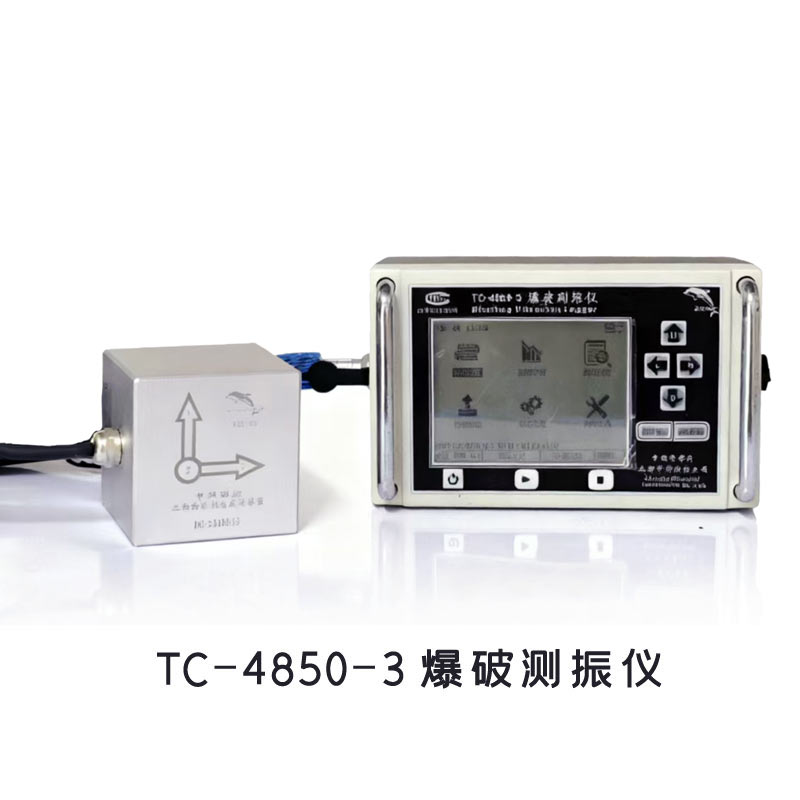 TC-4850 Blasting Vibration MeterPortable · Self-adaptive range · Fast deploymentView details →
 TC-4850N Network Vibration Meter3/6 channels · Solar + battery · Long-term onlineView details →
 6850 Integrated Network VibrometerVelocity + acceleration · Only 560g · OLED displayView details →
More Solutions
- Section: Solutions
- Platform: ZKCK Cloud (Online Monitoring)
