
 中文
Industry Solution · Underwater Blasting
Underwater Blasting Vibration Monitoring Solution
Shore-side vibration surveillance of quay & waterway blasting

Reef blasting in waterway dredging, quay foundation-trench excavation, underwater clearance — underwater blasting transmits energy through water-rock coupling, with both shock-wave and vibration paths. Impacts on hydraulic structures and aquatic life must be quantified. ZKCK provides an integrated underwater vibration + shock-wave monitoring scheme.
Pain PointsPAIN POINTS
Shock-wave and ground vibration coexist — measuring only one misses half the story.
Quays, locks, embankments and water-crossing bridges have low allowable velocity and long-term exposure.
Equipment must be waterproof and pressure-resistant; deployment and recovery are hard — a failure means downtime.
Low-frequency vibration in underwater blasting and soft soils travels far and harms more — conventional frequency response falls short.
Reference StandardsSTANDARDS
Underwater blasting vibration and shock-wave safety criteria
Underwater blasting construction and monitoring requirements
Technical requirements for waterway and quay blasting
Key ChallengesCHALLENGES
Underwater sensor sealing and fixing demand high craftsmanship; data recovery options are limited.
Shore and water points are scattered (onshore structures + underwater points) — synchronized comparison is required.
Overpressure and particle velocity must be evaluated separately — report structure is complex.
SolutionsSOLUTION
6850 / 4850N series
4G · WiFi · LAN
Alarm · Reports · Regulator upload
TC-4850-3/6
Underwater blasting special monitoring
Optional underwater shock-wave sensor + low-frequency velocity sensor (1–500 Hz) — vibration and shock-wave captured in one go; ≈1 TB storage; IP64 field protection
TC-4850N-3
Long-term online for shore-side structures
4G full-network + cloud remote download; external battery 30+ days + solar; 4-route alarms on exceedance (free)
Recommended combination: TC-4850-3/6 (water-land dual-field) + TC-4850N (long-term online)
Deployment & ParametersDEPLOYMENT
In water: lay shock-wave points per the code (sections at blast depth / safe distances).
On shore: triaxial velocity points at the quay edge, lock walls, embankments and the nearest houses.
For low-frequency conditions (soft soils, medium-deep holes), add the optional 1–500 Hz sensor to close the low-frequency blind spot.
When underwater structural response matters, the TC-4850Naccelerometer dual-outputs — velocity and acceleration judged together.
Multi-unit synchronized triggering on a common time axis; water/land data compared blast by blast for a complete impact-assessment archive.
Why ZKCKWHY ZKCK
Underwater shock-wave + triaxial velocity + acceleration — one system covers all.
Optional 1–500 Hz low-frequency sensor — no missed low-frequency vibration underwater.
CPA certificate — fisheries compensation and impact-assessment reports hold up.
Zero platform fees for long-term online monitoring.
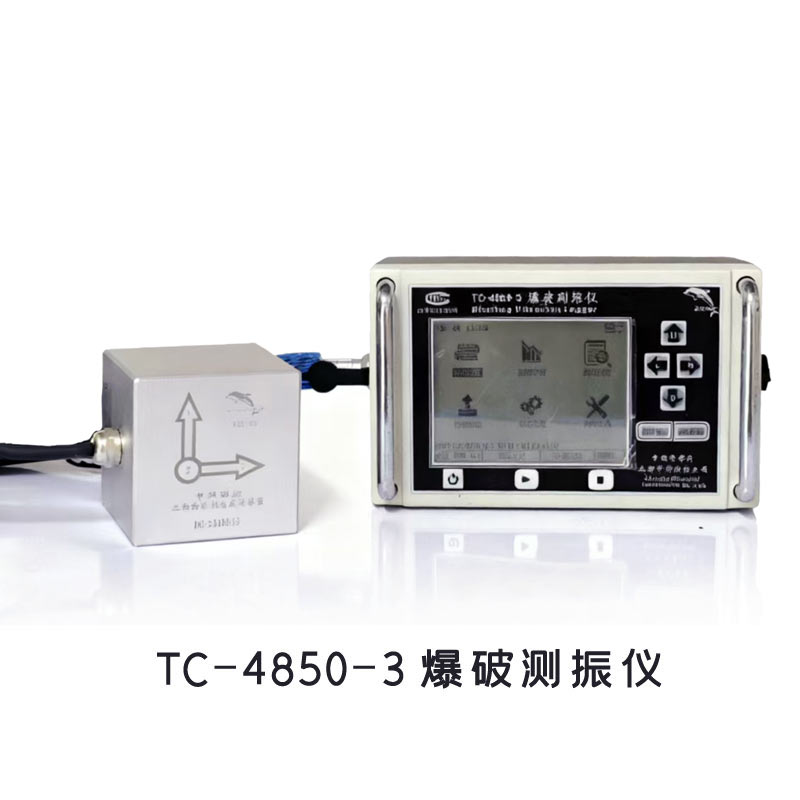 TC-4850 Blasting Vibration MeterPortable · Self-adaptive range · Fast deploymentView details →
 TC-4850N Network Vibration Meter3/6 channels · Solar + battery · Long-term onlineView details →
 6850 Integrated Network VibrometerVelocity + acceleration · Only 560g · OLED displayView details →
More Solutions
- Section: Solutions
- Platform: ZKCK Cloud (Online Monitoring)
