
 中文
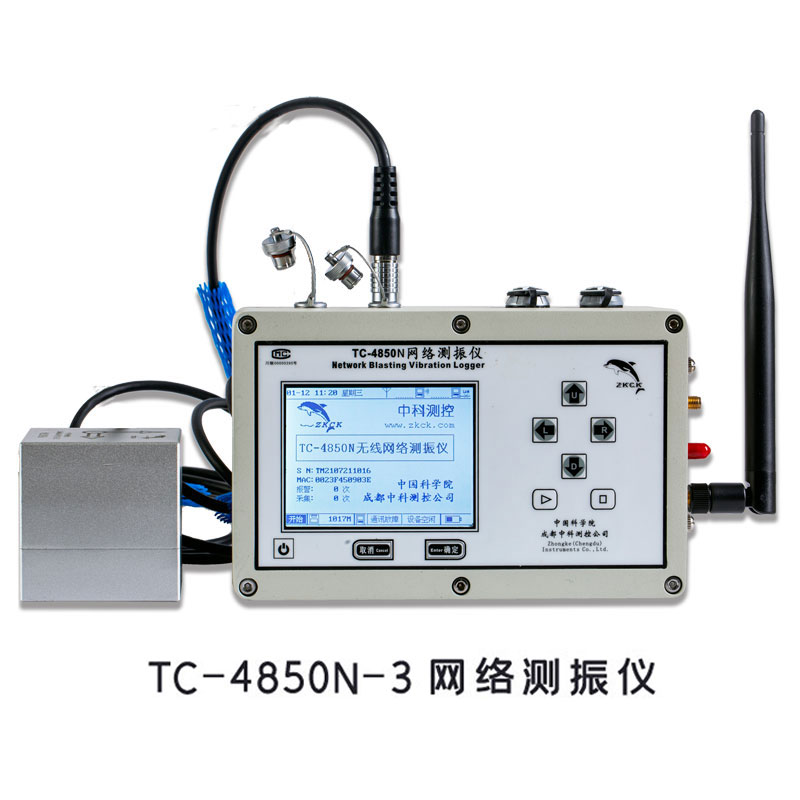
New-Generation TC-4850N-3/6 Network Vibr 4
For blastingThe high-performance TC-4850N wireless vibration meter developed by ZKCK is designed for vibration monitoring in engineering blasting environments. It suits long-term unattended real-time remote vibration monitoring for highways/railways, bridges and tunnels, mines, dam slopes and reservoir-bank stability. Test data reaches the cloud platform via WiFi or 5G/4G, enabling ultra-remote telemetry of vibration.
Channels
3/6-channel parallel acquisi…
Sampling rate
up to 100 K Sps, multi-step …
Range
self-adaptive (0-35 cm/s wit…
Resolution
0.0001 cm/s
Key Specifications
Parameters below are extracted from this page; values and units are kept verbatim.
A new-generation intelligent network blasting vibration meter, fully upgraded from the TC-4850N, with stronger functions and improved specifications. It supports 6-channel parallel acquisition with simultaneous velocity and acceleration output - the only instrument in the industry that connects two triaxial sensors at once, simplifying tests, improving efficiency and saving cost.
The TC-4850N works with the ZKCK cloud platform for intelligent remote monitoring and control of long-term unattended sites, transmitting wirelessly to a designated monitoring center to form an IoT network. Using 5G/4G/3G/2G all-netcom technology combined with the Internet and other multimedia communication, it achieves ultra-long-distance blasting vibration monitoring with telemetry, remote control and high-speed wireless data transmission.
The system is particularly suitable for projects with complex test environments or multi-track construction requiring long-term blasting vibration monitoring.
Also suitable for long-duration continuous vibration tests - vibration induced by dynamic compaction, piling, heavy machinery transport, etc. - and vibration monitoring and vibration-isolated foundation evaluation of precision equipment, large electromechanical and rotating machinery. With optional function, multiple units can locate vibration sources.


▲ Acquisition parameters
Channels: 3/6-channel parallel acquisition, cascadable
Sampling rate: up to 100 K Sps, multi-step adjustable
Range: self-adaptive (0-35 cm/s with standard sensor)
Resolution: 0.0001 cm/s
Reading accuracy: 0.1 %
A/D accuracy: 24 Bit
Clock accuracy: ≤5 s/month
▲ Recording parameters
Trigger mode: Level trigger mode(manual, single, continuous, external trigger, multi-unit synchronized trigger - e.g. routine blasting vibration tests)
Statistical mode(combined with level trigger,it records themaximum values of continuous vibration dataat 30 s - 1 h intervals,and also records instantaneous vibration data exceeding the threshold.Suitable for long-duration continuous vibration recording such as piling and dynamic compaction)
Trigger level: freely adjustable (0-35 cm/s with standard sensor)
Data output: simultaneous output ofvelocityandacceleration(with TCS-X3 sensors)
Record duration: 1 - 5590sfreely adjustable range
Delay: custom negative delay supported
Data overwrite: auto-overwrite supported
Storage: no less than1.8 million records locally,local equivalent of 1 T + unlimited cloud dual storage;
▲ Communication parameters
Wireless: Wi-Fi, 5G/4G all-netcom, 3G, 2G
Wired: USB / LAN / 485
Transfer rate: 100 Mbps high-speed Ethernet
Distributed control: Instruments in different regions centrally controlled via the Internet - remote management and batch control
Terminal display: PC, phone, handheld and other mobile clients
Alarm modes: SMS alarm, client UI alarm, official-account alarm push, API data push
▲ Physical parameters
Dimensions: main unit 185 mm × 120 mm × 75 mm; standard sensor 66×66×66 mm / 45×45×45 mm;
Weight: main unit 1.8 kg; standard sensor 0.687 kg;
Display: 3.7-inch LCD, Chinese/English, characteristic values and waveforms;
Power: 5-12 V wide-range supply; built-in battery works 3 days continuously; optional external battery extends runtime beyond 30 days;
Keypad: 9 touch keys;
Ports: all-aviation-connector I/O;
Environment: -30 to 75 ℃, 90 % RH, IP64 splash-proof;
▲ Data access
Connect to PC for data download
On-site USB batch download / on-screen data viewing /on-site direct printout(requires a POS printer)
LAN data access (WiFi, LAN)
Remote data access via cloud platform
Remote mobile data access (mini-program, app clients)
▲ Data analysis
Frequency spectrum, power spectrum, first-order calculus, high/low-pass filtering
2/3-vector composition
Sadovsky empirical formula for K and α
segment analysis
waveformmulti-windowdisplay, data comparison
▲ Event reports
Blasting vibration safety assessment per GB6722-2014 etc.
Safe-distance calculation for protected structures, safe charge calculation
Batch export with characteristic-value filtering,
single/multiple data batch export to standard reportsin Word/WPS/PDF formats
Per-round/staged statistical report export / statistical-mode report export
Export raw data in txt/dat/csv for secondary analysis
▲ Other functions
Positioning & timing (optional): BeiDou + GPS hybrid positioning; 3+ synchronized units enable source location, 1 ns accuracy, per-second sync
Scheduled remote power on/off; power-saving mode
Multi-level user permission management
Positioning system reads measuring-point coordinates
Local and remote zero calibration
USB-drive system upgrade; remote upgrade and maintenance
Batch one-click start/stop of multiple units
Active clock sync with the network information center
▲ Sensors & accessories selection
Standard: 4850N-3 with one triaxial velocity sensor; 4850N-6 with two triaxial velocity sensors; frequency range 5-500 Hz; range 35 cm/s; for routine vibration monitoring;
Low-frequency velocity:Optional:1-500 Hz triaxial velocity sensor for low-frequency signals, e.g. 1-10 Hz low-frequency vibration from medium-deep hole and chamber blasting, soft soil and underwater blasting;
High sensitivity: optional high-sensitivity triaxial velocity sensor for micro-vibration signals;
Acceleration: optional uniaxial/triaxial acceleration sensors for acceleration monitoring; ranges selectable;
Shock wave: optional air/underwater shock-wave sensors for blast-induced overpressure monitoring; ranges selectable;
Noise sound pressure:Optional noise sensor for sound pressure monitoring, covering steady, transient and impulse noise.
▲ Application fields
Construction environmental safety assessment Production and test sites in precision manufacturing, urban engineering, blasting engineering, traffic engineering and military tests
Blasting design optimization and research Blasting design verification/optimization, vibration data filing, research and teaching.
Long-term unattended monitoring; long-cycle, high-frequency or hard-to-reach projects Long-term monitoring of protected structures near operating railways, bridges, dams, historic buildings and high steep slopes.
Widely distributed, high-count observation points Vibration impact monitoring along high-speed railways, oil pipelines and other corridors.
Continuous vibration monitoring induced by other activities Vibration from dynamic compaction, piling, heavy machinery transport; vibration monitoring and vibration-isolated foundation evaluation of precision and rotating machinery.
Source-location function with multiple units - e.g. mine blast point location, impact point location
PreviousNew-Generation TC-4850-3/6 Blasting Vibration MeterNext6850 Network Vibration Meter - Mine Blasting Vibration Online Monitor
