中文
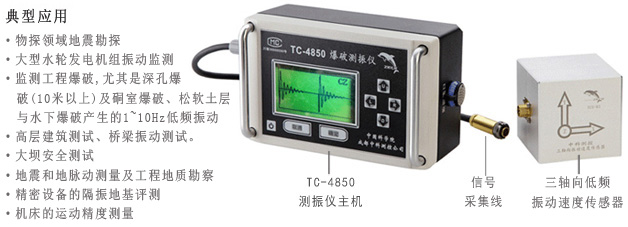
The blasting vibration meter can monitor the seismic wave vibration velocity
The seismic wave generated by blasting is a vibration wave with a broad frequency domain and complex composition. It propagates both along the ground surface and spherically; moreover, the earth as the propagation medium has its own non-uniformity and complexity, so obtaining test results simply and accurately is very difficult.
As is well known, the seismic wave generated by blasting is an elastic wave, comprising body waves propagating inside the medium and surface waves propagating along the ground; body waves can be divided into longitudinal and transverse waves. The longitudinal wave is the compression wave we usually speak of, also called the P wave. It propagates spherically through repeated compression and extension of the medium itself, with a fairly fast propagation speed. Based on our years of testing experience, its average propagation speed is more than twice that of the transverse wave (also called shear wave or S wave). Although the longitudinal wave is faster and higher in frequency, its destructive power to ground buildings is not great and it is quickly attenuated by loose soil, sand-gravel layers and cobble layers - though its influence should not be underestimated when it encounters a large area of hard rock strata.
Experience proves that although the transverse wave propagates more slowly and at lower frequency, it spreads laterally in circles along the ground surface like water waves in the form of vertical shearing of the medium, and its destructive power is very obvious. Therefore in blasting seismometry people pay more attention to the transverse wave, i.e. the vertical vibration wave directed toward the earth's center. For this reason, in China, until now, in many situations and for convenience, many units only measure vertical vibration, ignoring radial and horizontal vibration. But complex field testing tells us this method is simplistic and one-sided. Vertical vibration being greater than other directions is only a general rule - just as particle vibration nearer the blast source being greater than farther ones is only a general rule.
In our actual field measurements, due to the combined influence of the complexity of geological conditions and the reflection and superposition of seismic waves back and forth, the vibration in a specific direction is sometimes particularly obvious. In addition, the measuring point close to the blast source may record smaller data due to soft soil or trench attenuation, while the measuring point farther from the blast source on the other end may record larger data because the ground medium is hard and uniform. The above phenomena are not rare in field measurements, nor are they surprising. Therefore, the Blasting Vibration Research Committee of the Mining and Materials Processing Institute of Japan pointed out: In principle, three mutually perpendicular components should be measured simultaneously, rather than measuring only one of them. The U.S. Bureau of Mines also stipulated: The damage criterion of blasting vibration should be based on the largest of the three components. In this respect, China's current Safety Regulations for Blasting GB 6722-2003 has no clear explanation and provision on this issue, and in the implementation process in recent two years a consensus has basically been formed in China: generally all three components are measured; when the requirements are not strict, only one component is measured at some sites.
Our view is that where conditions allow, the direction and data of the three-vector resultant should prevail. Of course, in actual practice, if one only wants to compare vibration attenuation between different monitoring points, measuring only the largest component is also feasible.
To learn more about our blasting vibration meterswww.zkck.comand triaxial vibration velocity sensors, call 028-85238246