
 中文
Blasting Case of the West Elevated Viaducts, Nanjing
Monitoring Scene
Success case
Instrument
TC-4850
Category
Case Studies
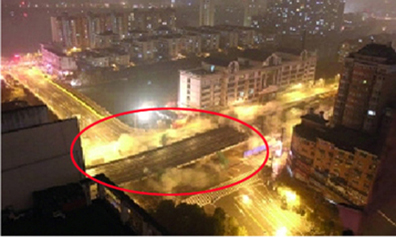
Blasting Case of the West Elevated Viaducts, Nanjing, Jiangsu
★ Satisfying technical support / free lifetime software & firmware upgrades - stable, reliable, industry leading ★★★
Tel: 13088055927 / 028-85238246
Summary: The TC-4850 blasting vibration meter developed by Chengdu Zhongke Chuankong (ZKCK) measures the vibration velocity and frequency at the monitored point during blasting. It can be used for blasting vibration monitoring and environmental safety assessment in various projects such as dams, bridges, tunnels, railways and highways, as well as various vibration monitoring in similar fields. It is also suitable as experimental teaching equipment for related majors in universities.
1. Site conditions and environment:
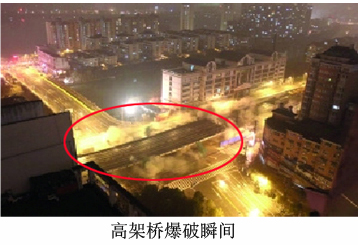
The Nanjing West City trunk road was proposed in the 1980s and realized in 1996 for the city's fast-transit upgrade. Located in the western main city, it comprises four viaducts - Shuiximen, Hanzhongmen, Qingliangmen and Caochangmen - close to the Ming city wall and the Qinhuai River in a bustling district. For the road-network upgrade, the Hanzhongmen viaduct demolition blasting was designed and guided by PLA University of Science and Technology, Nanjing. Given the downtown location and blasting safety concerns, to digitize the blast destructiveness for post-blast study and prevention, TC-4850 blasting vibration instruments from Chengdu Zhongke Chuankong were used on site to acquire vibration waves.
2. Blasting process and instrument usage
The blast started at pier 14 of the Hanzhongmen overpass (the first pier north of the Hanzhongmen intersection), proceeding pier by pier southward and northward; the Qingliangmen overpass was fired in line with the Hanzhongmen line in sequence. The Qingliangmen and Hanzhongmen overpasses and their ramps required about 1,200 drilled holes, 620 kg of explosive, 2,700 detonators, 700 m of detonating cord and 4,000 m of shock tube; total blast duration 4.8 s, fired at 21:58 on March 17, 2012. On site, 14 TC-4850 units covered 14 sensitive monitoring points; triaxial sensors were bonded to the ground with gypsum, instruments set to 8K sampling, 20 s record time, trigger level 0.05 cm/s.
3. Sampling results and customer feedback
After monitoring multiple important buildings along the viaducts, all points successfully acquired valid data, and the secondary collapse vibration waves from the bridge collapse were again effectively captured after the blast - providing scientific data to verify the blasting design and the impact on surrounding houses and historic buildings. Customer feedback on our instruments: convenient, practical, accurate acquisition. The data greatly helped reassure nearby residents, the digitized blast vibration waves strongly supported the research topic, and provided major guidance for the later Hanzhongmen viaduct blasting in the upgrade project! 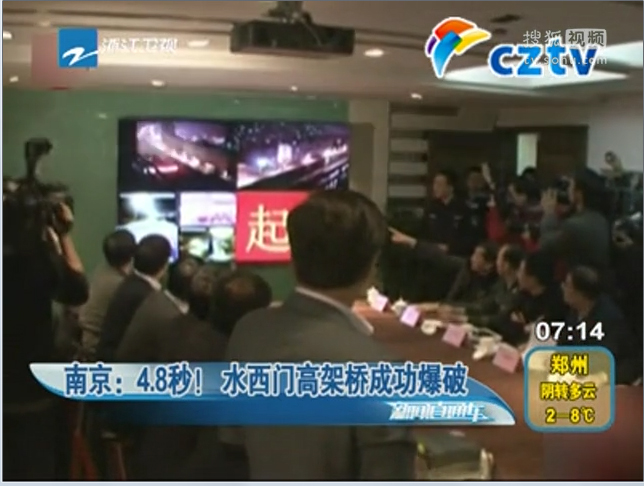 http://share.vrs.sohu.com/my/v.swf&autoplay=false&id=16189095&skinNum=1&topBar=1News: blasting of the Nanjing Shuiximen viaduct
- Previous: Mining impact on bridge and tunnel vibration monitoring
- Next: None
