
 中文
Abstract This paper expounds the necessity and feasibility of adopting both particle vibration velocity and frequency as blasting vibration safety criteria, and introduces the calculation formulas of blasting vibration frequency.
Keywords blasting vibration; vibration velocity; vibration frequency; safety criteria; blasting safety assessment standards
The energy released by explosive detonation manifests in two forms: shock waves and explosion gases. As the propagation distance increases, the shock wave attenuates into stress waves and seismic waves. The (near-surface) ground vibration caused by seismic waves is called ground motion. China's Blasting Safety Regulations (GB6722-86) stipulate that the blasting seismic safety of general buildings and structures should satisfy the safe vibration velocity requirement - i.e. the current regulation expresses ground motion intensity by particle vibration velocity. Practice shows this provision basically meets the requirements of engineering blasting and provides a legal basis for determining blasting safety distances. However, with in-depth research on blasting technology, it has been found that using a single particle vibration velocity as the sole index of ground motion intensity has many drawbacks, and it is hoped that peak particle vibration velocity and the corresponding frequency (velocity and frequency for short) serve as vibration intensity indexes. Developed countries such as the US and Germany have already considered the combined influence of vibration velocity and corresponding frequency, incorporating both indexes into blasting vibration safety criteria.
1. Necessity of Using Velocity-Frequency as the Vibration Intensity Index
1.1 Theoretical Necessity
Ground motion is a random process combining waves of different frequencies and amplitudes within a limited time range. The peak (maximum amplitude), frequency and duration of ground motion are called the three elements of ground motion; the maximum amplitude is closely related to velocity and acceleration - given any one of displacement, velocity and acceleration, the other two can be obtained by integration or differentiation. Therefore the velocity, frequency and duration of ground motion are three indispensable parameters characterizing ground motion intensity, especially the first two (velocity and frequency) which are indispensable.
1.2 Necessity from Engineering Practice
The structural response to blasting vibration is also closely related to frequency characteristics.
(1) As is well known, when the dominant period of the ground motion input to a building foundation approaches the building's natural vibration period, resonance produces larger vibrations and can easily damage the building. In blasting engineering we occasionally find that, other conditions being equal, a building near the blast source is undamaged while a farther one is damaged. This is because buildings and structures are of many kinds with various structures, blasting types are numerous, initiation methods differ, and the blasting conditions and media through which the blasting seismic waves pass are complex. With the same ground particle vibration velocity, buildings (structures) will exhibit different vibration frequencies and durations. Even for the same structure under the same vibration velocity, different vibration frequencies and durations have different dynamic effects on the structure.
(2) In natural earthquakes of intensity 7-9, the average seismic acceleration is 0.075-0.3g, and most houses are damaged. But under such a large blasting ground motion, the impact on ordinary houses is small, because the natural vibration periods of ordinary houses are mostly within 0.2-1.0 s (frequency 1-5 Hz), while the acceleration frequency of natural earthquakes is mostly between 2-5 Hz and rarely exceeds 10 Hz - the two frequency ranges are fairly close. But the acceleration frequency of blasting ground motion is mostly 10-30 Hz, even up to 50 Hz, far higher than the natural frequency of ordinary houses, hence they are not easily damaged. This also illustrates the importance of vibration frequency from another aspect.
1.3 Necessity from Foreign Development Trends
Using velocity-frequency as the ground motion intensity index is also the popular expectation. Currently, foreign indexes of particle vibration intensity include displacement, velocity, acceleration and frequency, with provisions varying by country. For example, the US early on used acceleration as the ground motion intensity index, while the UK, Portugal, Canada, Sweden and Russia adopted particle vibration velocity. However, since the main factors damaging buildings (structures) under blasting vibration are velocity and frequency, considering a single factor alone is unreasonable. Therefore, major Western countries generally consider the joint influence of velocity and frequency when formulating blasting vibration safety standards. Examples follow.
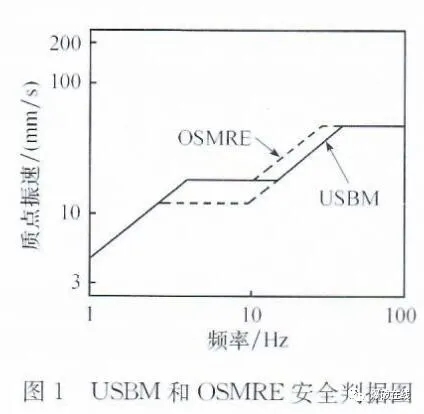
(1) The US blasting vibration safety criteria. Different industry sectors set different safety criteria according to the protection degree of buildings. The US Bureau of Mines (USBM) and the Office of Surface Mining Reclamation and Enforcement (OSMRE) each formulated their own standards; combining the two produced the internationally popular blasting vibration safety criterion (Figure 1).
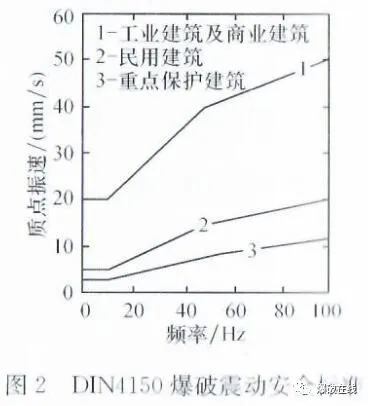
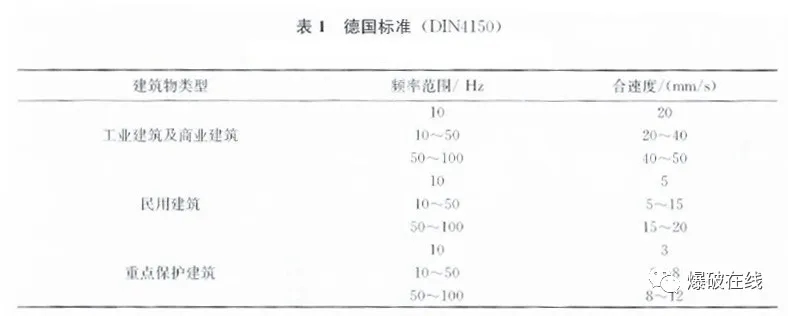
(2) The German blasting vibration safety criterion (DIN 4150). Buildings are divided into three types: (1) industrial and commercial buildings; (2) residential buildings; (3) specially protected buildings. It comprehensively considers the maximum particle velocity and vibration frequency caused by blasting, fully reflecting the impact of blasting vibration of different frequencies on buildings, as shown in Figure 2 and Table 1.
1.4 Necessity from International Alignment
China's WTO accession is a foregone conclusion. After China became a WTO member, large foreign engineering companies (including blasting companies) entered the Chinese market, and Chinese blasting workers will have more opportunities in the international market. Undoubtedly, using the internationally popular advanced blasting vibration safety criteria in international blasting project bidding is favorable for winning contracts; from this perspective, velocity and frequency should also be introduced into China's blasting vibration safety criteria.
2. Feasibility of Using Velocity-Frequency as the Vibration Intensity Index
It can be said that China now possesses the basic conditions for using velocity-frequency as the vibration intensity index and it is feasible to incorporate both into blasting vibration safety criteria. The main bases are:
(1) The experience of many foreign countries can be drawn upon, especially the US and German standards which have been in force for many years.
(2) Many domestic units have conducted extensive observations with internationally advanced instruments and accumulated rich data. For example, the US NCSC5000 computer-controlled digital-output seismograph (NOMIS COMPUTER SYSTEM CORPORATION 5000 Portable Microprocessor Based Digitizing Seismograph) consists mainly of a solid-state computer, thermal printer and rechargeable battery, with a triaxial sensor and noise-measurement microphone as accessories. It can measure triaxial particle vibration velocity and its vector sum, vibration acceleration, particle displacement, vibration frequency, noise intensity and noise frequency, plot particle velocity vs. frequency and seismic waveforms, and draw USBM/OSMRE safety criterion charts or the DIN 4150 blasting vibration safety standard. Results are printed by the thermal printer within 1 minute after blasting. The NCSC5000 is easy to use, strongly interference-resistant and highly accurate - the most advanced equipment for blasting seismic testing worldwide.
Domestically, the above advanced instruments have been used for considerable observations of chamber blasting, bench blasting, demolition blasting, etc., yielding a batch of valuable data.
(3) In recent years, under the organization of the Third Bureau of the Ministry of Public Security and the China Society of Engineering Blasting, systematic training and assessment of engineering blasting technicians nationwide have significantly raised the quality of industry technical personnel, qualifying the industry to implement advanced international blasting vibration safety standards.
3. Specific Suggestions for Adopting Velocity-Frequency as the Vibration Intensity Index
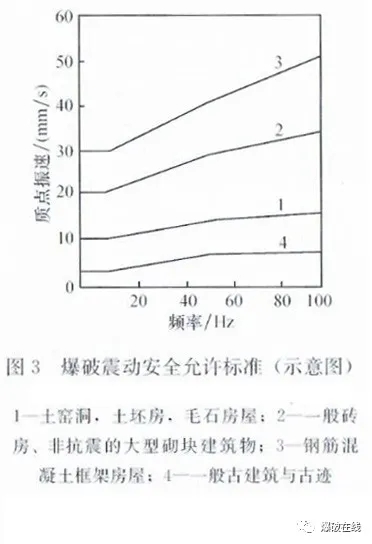
(1) Absorb the useful data and experience of relevant foreign standards, and formulate provisions of China's new Blasting Safety Regulations based on the measured data already mastered by Chinese blasting technicians - i.e. the blasting vibration safety criteria of rock blasting for ground buildings and tunnels may adopt two indexes: ground particle velocity and main vibration frequency. The corresponding velocity is determined by different frequency bands of the main vibration frequency, in a basic form similar to Figure 3. The categories of ground buildings and tunnels in the figure may be appropriately expanded based on existing data.
(2) Establish a table of natural vibration periods of common buildings (structures). To prevent resonance caused by blasting vibration frequencies close to the natural frequencies of buildings (structures), their natural frequencies or periods must be known. Table 2 lists the natural periods of common buildings (structures) [1].
(3) Calculation of blasting vibration frequency. Currently there are two formulas in China for calculating blasting vibration frequency.
Reference [2] proposes calculating the ground particle vibration frequency caused by blasting ground motion with the following formula:
f=( kfC7/5s./ Q1/3 ) • ( Q1/3 / R)2/5 (1)
where kf is the frequency coefficient, kf = 0.01-0.03; Cs is the rock S-wave velocity, cm/s; Q is the total charge initiated simultaneously at the same distance, kg; R is the distance from the monitoring point to the blast source, m.
Reference [3] proposes the following vibration frequency formula:
f=k(Q1/3 /logR)1/2 (2)
where k is a coefficient: for chamber blasting k = 0.8-5.0; for bench blasting k = 5.0-50; for demolition blasting k = 1.0-10; take the smaller value for large charges and vice versa. Both formulas are empirical formulas obtained under certain test conditions - a useful exploration for calculating blasting vibration frequency. They may be tried, but including them in the new Blasting Safety Regulations is not yet ripe.
4. Conclusion
After analyzing the necessity and feasibility of adopting velocity-frequency as the vibration intensity index in China, the author proposes that when formulating China's new unified Blasting Safety Regulations, the combined influence of velocity and frequency should be considered - i.e. taking vibration velocity and main vibration frequency as the blasting vibration safety criteria. It is also pointed out that, given the absence of an ideal and universally accepted vibration frequency formula, the only feasible approach at present is to set the peak particle velocity and corresponding frequency at the locations of protected ground buildings and tunnels based on China's existing measured data, substituting empirical data for calculation formulas.
References
[1] Huang Jishun, Jiang Zhiguang. Engineering characteristics of blasting vibration and its safety technical measures. Proceedings of Engineering Blasting (Vol. VI). Shenzhen: Haitian Press, 1997.
[2] Jiao Yongbin. A preliminary study on blasting seismic safety assessment criteria. Blasting, 1995, (3): 45-47.
[3] Tang Chunhai et al. A preliminary discussion on blasting ground motion safety criteria. Nonferrous Metals (Quarterly), 2001, 53(1): 1-3.
Excerpted from "Selected Papers of Academician Wang Xuguang"
