
 中文
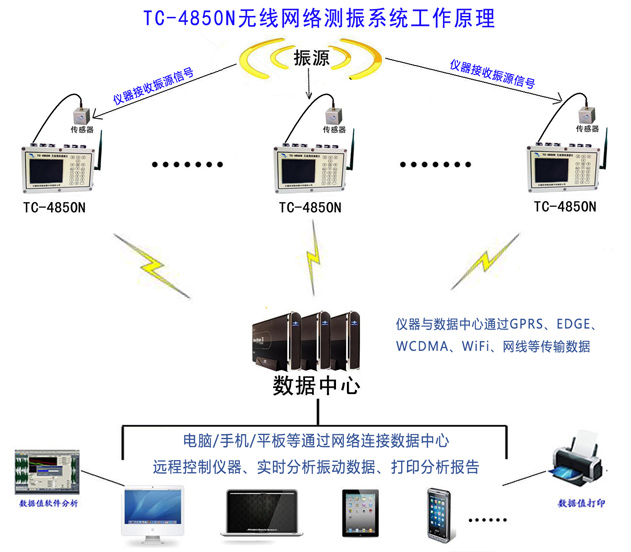
Introduction to the application of low-frequency and high-sensitivity sensors for blasting vibration meters. For the following application scenarios, our company has specially developed low-frequency sensors and high-sensitivity sensors, thoroughly solving low-frequency signal loss and higher accuracy requirements. Combined with our TC-4850 blasting vibration meter and TC-4850N network vibration meter in various combinations, they meet the different needs of various users.
1. For monitoring and recording engineering blasting:
Especially the 1-10 Hz low-frequency vibration generated by deep-hole blasting (over 10 m), chamber blasting, soft soil and underwater blasting.
2. Vibration monitoring and fault diagnosis of large hydro-turbine generator units:
The rotation speed of large hydro-turbine generator units is about 60 r/min (rotational frequency 1 Hz). For example, the two unit types at Gezhouba rotate at 62.5 r/min and 54.5 r/min; Three Gorges units at 71.4 r/min or 75 r/min. The vibration caused by water vortex is about 1/3 of the rotation speed, i.e. about 0.3 Hz. Some medium-high-head units and pumped-storage units rotate at about 150-200 r/min (close to 3 Hz).
3. Bridge vibration testing:
The spans of ordinary highway and railway bridges are 30-60 m, with natural frequencies around 2 Hz or slightly higher. The 420 m deck-type concrete arch bridge at Wanxian, Three Gorges of the Yangtze, is the world's largest reinforced concrete arch bridge; measurements show its first transverse vibration frequency is 0.2 Hz and first vertical natural frequency 0.39 Hz. The Qinjiatuo Bridge at Three Gorges is Asia's highest-capacity bridge, with three spans of (80+130+80) m, and is a key bridge on the Three Gorges transport line. Its measured natural frequencies: first vertical 1.12 Hz; first transverse 1.55 Hz. The first natural frequency of long-span cable-stayed bridges is about 0.2-0.5 Hz. The south branch bridge of the Nanjing Yangtze Second Bridge has spans of (305+628+305) m; measured natural frequencies: first vertical 0.261 Hz; first transverse 0.269 Hz. Suspension bridges have even larger spans. The Hong Kong Tsing Ma Bridge is (333+1377+306) m long; its measured natural frequencies: first 0.067 Hz; second 0.119 Hz.
4. High-rise building testing:
The natural frequency of high-rise buildings varies with structure and height. The first natural frequency is roughly (10-25)/N, where N is the number of floors. The second and third natural frequencies are about 3-4 times and 6-8 times the first. In light wind, the rooftop pulsation amplitude of high-rise buildings is generally 5-10 micrometers, with acceleration between (10^-4-10^-5) g. Tall structures are another class of low-frequency structures. The Hainan TV Tower, 388 m tall, measured first frequency 0.32 Hz. Offshore platforms are also low-frequency structures, and they long remain in harsh environments.
5. Dam safety testing:
Dams are also low-frequency structures. Gravity dams have relatively high natural frequencies. For example, the Longyangxia Dam, 175 m high and 342 m long, has first, second and third natural frequencies of 3.4 Hz, 5 Hz and 7.5 Hz. Arch dams are lighter in structure with lower natural frequencies than gravity dams. The Dongjiang Arch Dam in Hunan, once damaged by earthquake, is 157 m high and 438 m long; its first natural frequency is 1.25 Hz, second 1.9 Hz.
6. Earthquake and ground microtremor measurement and engineering geological survey:
Earthquakes and ground microseisms (often mixed with ground pulsation in engineering) are broadband random vibrations. Since high-frequency vibrations attenuate quickly in the ground strata, the surface mainly receives low-frequency vibration signals. The predominant frequency of sites of interest in buildings is generally within 2-10 Hz. When using Rayleigh surface waves to study deep strata structures, the low-end frequency should be further lowered. In engineering seismic monitoring, such as reservoir-induced earthquake monitoring, sensor requirements are similar to ground pulsation measurement. Ground pulsation frequency is generally 2-50 Hz, amplitude generally micron or sub-micron level, acceleration at the (10^-5-10^-7) g level.
7. Evaluation of vibration-isolated foundations for precision equipment:
Precision calibration equipment, integrated circuit process equipment, etc. all require vibration-isolated foundations. General isolation measures are very effective for reducing high-frequency vibration but of little use in isolating low-frequency vibration. If the equipment's design stiffness is large, at low frequencies the equipment sways as a whole with no perceptible relative motion between parts - so the foundation need not be overly demanding. Measurements of the vibration of a coordinate measuring machine table show the table vibration is often larger than its foundation. This is because the support system between the table and foundation is a spring-mass system with a low natural frequency; low-frequency foundation vibration is amplified by the resonance gain of the support system.
8. Motion precision measurement of machine tools:
Mainly the evaluation of motion smoothness and determination of motion error of machine tools and some precision calibration equipment. For example, measuring the motion smoothness of a gear-hobbing machine table with sensors to analyze the drive-chain error. For centrifugal tables calibrating precision acceleration sensors, sensors should measure rotation uniformity and table eccentricity to compensate for motion error.
The above is the introduction to the application of low-frequency and high-sensitivity sensors for blasting vibration meters. For more informationhttp://www.zkck.com/
