
 中文
I. Blasting Earthquake Effects and Monitoring Process
Explosive detonation produces shock waves; as this wave propagates in rock, it gradually attenuates into stress waves with gradually decreasing energy. When it no longer breaks the rock, it can only cause elastic vibration of rock particles, forming seismic waves. The energy of seismic waves accounts for only 2-6% of the total explosion energy. According to different seismic wave propagation paths, they can be divided into two categories: one propagates inside the rock mass, called body waves; the other propagates along the rock surface, called surface waves. Body waves can be divided into longitudinal and transverse waves, and surface waves can be divided into Rayleigh waves and Love waves. Among them, Rayleigh waves have low frequency, slow attenuation, large amplitude, long period and disturbance duration, carry great energy, and are the main factor causing blasting earthquakes.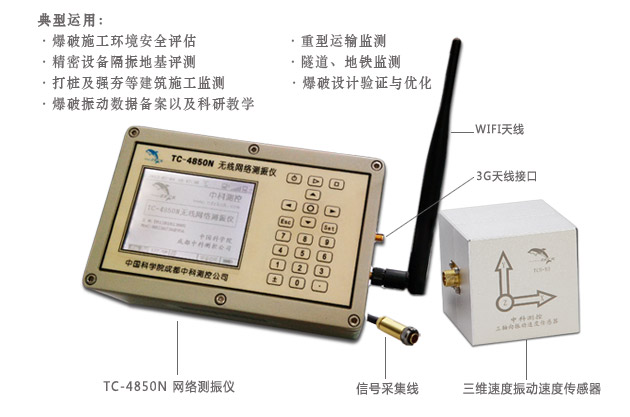
1. Methods for safety evaluation of blasting earthquakes
There are mainly three methods: the blasting earthquake intensity method, the dynamic analysis method and the single-parameter method. The first two methods are rarely adopted due to insufficient precision or imperfect theory. The control indicators of the single-parameter method include the maximum ground particle vibration velocity, maximum acceleration, maximum displacement, energy ratio, etc., among which the particle maximum vibration velocity method is the most convenient, and most countries adopt it as the safety evaluation standard.
In China's Safety Regulations for Blasting (GB 6722-2014), the blasting vibration criterion for ground buildings adopts the peak vibration velocity and dominant vibration frequency at the location of the protected object. The particle vibration velocity can be synthesized from the mutually perpendicular horizontal radial velocity, horizontal tangential velocity and vertical velocity; since the horizontal radial velocity and horizontal tangential velocity are both small, we only need to measure the vertical velocity.
2. General process of blasting vibration monitoring
2.1 Selection of measuring points
Ground buildings and structures are the protected objects. According to existing research results, during blasting, the velocity peak of the foundation is greater than that of the columns; the velocity peak of the columns is greater than that of the walls, roof panels and ring beams; the velocity peak of the upper surface of the foundation is greater than that of the lower surface; the velocity peak below the wall is greater than that above the wall. Therefore, the upper surface of the foundation is selected as the measuring point; if the foundation is buried under the soil layer, the apron closest to the foundation and solid is selected as the measuring point.
2.2 Arrangement of probes
Generally speaking, if the geological conditions are unchanged, the vibration velocity of points close to the blast source is greater than points far from it. Therefore, the building closest to the blast source is selected as the protected object. The probe is placed on the foundation at the corner; through extension cables, one instrument can simultaneously measure the vibration velocity at three points, in order to more comprehensively understand the impact of blasting on the entire building. The probe needs to be firmly bonded to the foundation with plaster.
3. Implementation of on-site monitoring
After the monitoring point positions are determined, use gypsum powder mixed with water into a paste, and bond the sensor to the measuring point on the flat surface in the tunnel; after about 10 min the gypsum solidifies and testing can proceed. During installation, the vertical velocity sensor should be kept as perpendicular to the horizontal plane as possible; the horizontal velocity sensor should be installed parallel to the horizontal plane; the horizontal velocity sensor has a bubble in the horizontal direction, and when installed in a horizontal state the bubble should be at the middle position of the scale. If three-direction velocity testing is adopted (vertical, radial, tangential), the vertical sensor measures the vertical velocity, and the two horizontal sensors measure the radial and tangential velocities respectively. The radial horizontal sensor should be installed horizontally pointing to the blast center, and the tangential horizontal velocity sensor should be perpendicular to the radial and keep level with the ground.
II. Matters needing attention in blasting vibration monitoring
The selection of blasting vibration monitoring points should pay attention to the following points:
(1) To ensure the safety of the tunnel structure, measuring points need to be reasonably arranged in the tunnel.
(2) The number of measuring points should be sufficient, so that there are enough data to analyze the attenuation law of ground vibration propagation and its relationship with parameters such as blast center distance.
(3) The influence of different landforms and geological conditions should be considered, to facilitate understanding and analyzing the influence laws of these factors on blasting vibration effects.
(4) The number and layout of measuring points can be adjusted according to actual conditions.
III. Analysis of blasting vibration monitoring test results
(1) Waveform analysis
The characteristic of blasting vibration waveforms is multiple vibrations at short intervals, because one blasting is usually initiated in segments; each segment of blasting will produce different vibration peaks according to changes in charge quantity and blasting conditions (such as different confinement conditions, blasthole dispersion, charging structures, etc.). Therefore, in waveform analysis, according to the peak changes at different times, the peak vibration velocities corresponding to different initiation segments are first identified; in this way, one blasting vibration measurement can obtain more peak vibration velocity information under different scaled distance conditions, increasing the reliability and accuracy of statistical analysis of vibration data, and also improving the efficiency of vibration testing.
(2) Dominant vibration frequency
Today, the accompanying software of blasting vibration testers all include FFT analysis tool software; in the future, multiple analysis methods such as wavelet analysis and HHT analysis need to be provided. Selecting the concerned vibration waveform segment for spectrum analysis is an important part of test result analysis; spectrum analysis needs unified regulations. This analysis software already comes with dominant frequency calculation, which can be viewed directly.
(3) Vibration duration
The blasting vibration duration is divided into the duration of one wave segment and the total blasting vibration duration. One wave segment can be divided into the main vibration segment and the tail vibration segment. From the first arrival wave to the amplitude decaying to A = Amax/e is the main vibration wave, and the duration of the main vibration wave is the duration of the segment wave. According to the duration of the segment wave, a reasonable millisecond delay initiation interval can be determined, and the damping characteristics of the medium can be analyzed. The total blasting vibration duration refers to the duration from the beginning to the end of the vibration wave; in most cases, the total blasting vibration duration is not of concern, but it is also one of the important indicators reflecting the strength of blasting vibration, and has certain significance when considering vibration fatigue damage.
(4) Seismic wave propagation velocity (Vw)
Using the seismic wave waveform time scale, the time of the wave first arriving at each measuring point can be read, calculating the time difference of the first arrival waves at different measuring points (tW = tB - tA), and the distance difference from different measuring points to the blast source (RW = RB - RA); the seismic wave velocity VW = RW / tW. When the measuring points are too close, the time difference is too small; if the sampling frequency is too low, the seismic wave velocity calculation has low precision and large errors. Therefore, when wave velocity calculation is needed, the distance between the two points should be increased, and simultaneous triggering and recording of the two measuring points should be ensured.
IV. Engineering Example of Blasting Vibration Monitoring
A certain tunnel is a new urban highway tunnel built by a city to improve traffic conditions for entering a scenic area; it connects X Mountain Road and X Mountain South Road, is located on the east side of a lake, and passes through the mountain. Above the tunnel crown there is a building complex.
The tunnel has a design clear width of 15 m and a total length of 1739.99 m, with chainages of k0+365.738 to k1+159.728. The section crossing the building complex has a total length of 303 m, with chainages of k0+717 to k1+020. The buildings of the complex are brick-concrete structures. According to the requirements of the Safety Regulations for Blasting (GB 6722-2014), during the construction blasting excavation of the building complex section of the tunnel, the ground particle vibration velocity of its buildings needs to be monitored, and blasting construction operations are carried out under the guidance of the monitoring data.
1. Blasting vibration monitoring
1.1 Monitoring instruments and methods
This blasting vibration monitoring adopted a test system composed of a wireless network blasting vibrometer, three-vector vibration velocity sensors, etc.
The vibration sensor in this test system is a three-in-one sensor simultaneously monitoring the x, y, z three directions. During measurement, the vibration tester automatically collects and stores relevant data, and transmits them to the cloud server via mobile phone signals; where there is network, the network vibrometer can be controlled at any time. The results are analyzed in time to guide the design of the next blasting scheme, and personnel do not need to go to the instrument to collect data each time.
Since the blasting vibration effect gradually attenuates with increasing propagation distance, each test is basically conducted at the measuring points closer to the blasting point. After each measurement, the test results are immediately organized and analyzed; with reference to the monitoring data, combined with the tunnel burial depth and the distribution of surrounding buildings, the parameters and construction progress of the next blasting are determined, thereby ensuring the smooth and safe progress of blasting operations.
1.2 Layout of monitoring points
According to the spatial position and distance between the building complex and the tunnel, a total of 22 monitoring points were arranged on the floors of the buildings of the complex. Among them, on the portal end, from k0+700 to k0+880, 13 measuring points were arranged at intervals of about every 12-16 m; on the exit end, from k0+900 to k1+040, 9 measuring points were also arranged at intervals of about every 15-18 m.
1.3 Monitoring results
A total of 79 sets of data were obtained.
2. Regression analysis of blasting vibration monitoring results
In the early stage of monitoring, 2 regression analyses of the blasting seismic wave propagation attenuation monitoring results were performed based on the measured data; the 1st was regression analysis based on the data measured when construction reached k0+567; the 2nd was regression analysis based on the data obtained when construction reached k0+679, which will provide the basis for timely adjustment of the blasting design scheme.
2.1. Regression mathematical model
According to China's Safety Regulations for Blasting (GB 6722-2014) and some research results at home and abroad, the Sadovsky empirical formula is generally adopted for the propagation and attenuation laws of blasting vibration in China and the former Soviet Union region.
Existing research shows that in prediction, the main factors such as propagation medium conditions, explosive quantity and the distance from the blast center to the measuring point were considered, but factors such as the elevation difference between the measuring point and the blast center and the dominant frequency of blasting vibration were ignored; and these factors are also the main factors affecting particle vibration velocity under certain specific conditions. Also, since the elevation difference between the measuring points is not within the range of 0.5 m to 1.5 m, the influence of elevation difference on seismic wave propagation must be considered. Therefore, in tunnel excavation blasting construction, in order to make the blasting vibration prediction more accurate and consistent with actual conditions, an elevation difference influence coefficient should be added to the particle vibration velocity prediction formula.
2.2 Analysis of regression results
From the monitoring data, before entering the building complex section, the vibration velocity measured on the ground directly above the tunnel blasting point was basically between 1 and 6 cm/s; after entering the building complex section, through the information feedback of blasting monitoring, the charge quantity was gradually adjusted so that the vibration velocity values measured on the floors of the buildings of the complex were all less than 1.5 cm/s, with more than 95% less than 1.0 cm/s, complying with the requirement of the Safety Regulations for Blasting (GB 6722-2003) that the ground particle vibration velocity of brick buildings must not exceed 2-3 cm/s. Its information-based blasting construction monitoring well guided the blasting operations of subsequent tunnel stages.
3. Blasting vibration control technology Blasting vibration monitoring
3.1 Select a reasonable blasting time difference
For the short-advance tunnel construction blasting project of this study, a reasonable time difference interval was adopted between the rows of blastholes of low segments, and it was ensured that the dominant vibration frequency was not close to the natural frequency of the protected building, while preventing superposition between seismic waves. Therefore, in order to prevent the later seismic wave from superimposing with the previous segment, the number of segments of the nonelectric shock tubes (or electric detonators) used should be appropriately increased, so that the blasting time difference between segments is ≥100-150 ms, thereby determining a reasonable millisecond delay time.
3.2 Control the maximum charge quantity Q per segment
This blasting vibration monitoring shows that when the initiation charge quantity is reduced, the particle vibration velocity can be reduced, achieving the purpose of vibration reduction.
3.3 Adopt millisecond delay initiation
In blasting construction, by appropriately arranging the initiation sequence, adopting skip-segment initiation and multiple batch initiation, the arch structure of the blasted rock that would first be destroyed is given a self-collapse tendency, achieving the purpose of reducing the charge quantity.
3.4 Control the excavation advance
To control the per-segment charge of the total charge, the advance in the interchange section is controlled within 1 m, the blasting advance in other sections is controlled within 1.5 m, and staged and sectional small pilot tunnel excavation is adopted, thereby controlling the per-segment charge and keeping the blasting vibration effect at a low level.
3.5 Adopt presplit blasting
Practice shows that the vibration reduction rate of presplit blasting is mostly above 30%, and the vibration reduction rate of presplit blasting with good effect can reach more than 50%; presplit blasting has become a commonly used effective vibration reduction measure. Therefore, presplit blasting can be appropriately adopted for the blasting project of this study to reduce blasting vibration.
V. Concluding Remarks
Only by conducting repeated blasting tests before entering the building complex section and, based on the monitoring data and their regression analysis, further optimizing and adjusting the blasting parameters, and taking measures such as controlling the excavation advance, controlling the maximum charge per segment, multiple batch initiation, and staged and sectional small pilot tunnel excavation, was the blasting vibration effect controlled at a low level, thereby ensuring the safety of the surface building complex and the safety of blasting operations.
Learn about blasting vibration monitoring technology discussion, blasting vibration monitoring, blasting vibration monitors and blasting vibration analysis; follow Zhongke Measurement and Controlwww.zkck.com blasting vibration monitor series products. Know more about blasting vibration monitoring issues!
