
 中文
Zhangjiajie-Jishou-Huaihua Railway Remote Tunnel Vibration Monitoring
Monitoring Scene
Success case
Instrument
—
Category
Case Studies
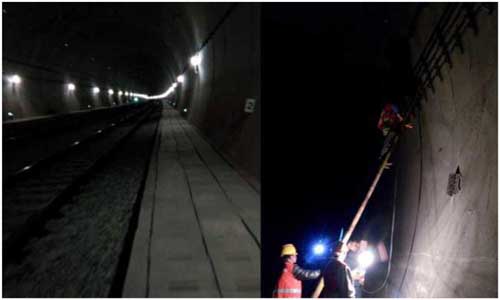
Zhangjiajie-Jishou-Huaihua railway remote wireless tunnel vibration monitoring
The Xinhuashan Tunnel of the new Zhangjiajie-Jishou-Huaihua railway is in Zhangjiajie City and Yongshun County, Xiangxi, Hunan, 5,930.49 m long - a 350 km/h single-tube double-track tunnel. It undercrosses the Jigongya Tunnel of the existing Jiaoliu Railway; the undercrossing section is in weakly weathered dolomite overlain by dark-grey carbonaceous shale, Grade V surrounding rock, moderately water-rich.
The 1068 m Jigongya Tunnel of the Jiaoliu Railway has weathered dolomite at the undercrossing, monolithic lining with 35 cm arch and 35 cm sidewalls. Site inspection shows no spalling, cracks or leakage in the lining within 50 m of the crossing; the tunnel operates normally.
Relative position: the Xinhuashan Tunnel undercrosses the existing Jigongya Tunnel at railway chainage DK27+138.83.
Blasting seismic intensity is monitored to guide blasting construction and improve efficiency; on the other hand it provides accurate, fast information for safe train operation, enabling timely prediction and forecast of possible dangers, feeding results back to decision-makers to improve plans and take measures, avoiding accidents, ensuring the safety of protected persons and buildings around the work zone, avoiding disputes and benefiting the enterprise. This monitoring of the Xinhuashan Tunnel blasting impact on the Jigongya Tunnel obtained peak particle velocities and dominant frequencies at monitoring points.

Solution:
The monitoring system consists of a cloud vibration data acquisition box, triaxial velocity sensors, a public-network server data center and clients. Before testing, fix the sensors, power on, ensure network connection and leave the site; after remote parameter setting and acquisition start via computer, the instrument enters working state. When a blasting vibration signal arrives, the system automatically records the full dynamic waveform, converts it to digital and transmits it to the cloud data center. Technicians far from the site can analyze data via terminal software and monitor system status in real time - ideal for long-term unattended vibration monitoring. In areas without mobile coverage, optical fiber carries the data signal to a 4G-covered area for Internet access.
Testing verifies the rationality of the blasting plan and parameters, providing a basis for controlling and optimizing them; it measures vibration impact on vibration-sensitive buildings and rock-soil bodies, assesses their safety per codes and design standards, and supports controlling or adjusting blasting parameters.

