
 中文
User Report - Yangtze River Scientific Research Institute
Monitoring Scene
Vibration Monitoring
Instrument
TC-4850
Category
Case Studies
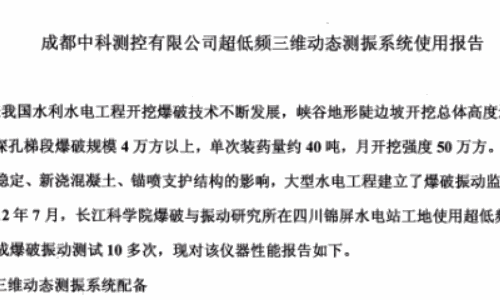
User Report on the Blasting Vibration Meter by Yangtze River Scientific Research Institute
★ Satisfying technical support / free lifetime software & firmware upgrades - stable, reliable, industry leading ★★★
Tel: 13088055927 / 028-85238246
Summary: The TC-4850 blasting vibration meter developed by Chengdu Zhongke Chuankong (ZKCK) measures the vibration velocity and frequency at the monitored point during blasting. It can be used for blasting vibration monitoring and environmental safety assessment in various projects such as dams, bridges, tunnels, railways and highways, as well as various vibration monitoring in similar fields. It is also suitable as experimental teaching equipment for related majors in universities.
User Report on the Ultra-low-frequency 3D Dynamic Vibration Measurement System of Chengdu Zhongke Chuankong Co., Ltd.
1. Overview
With the continuous development of excavation blasting in China's water conservancy and hydropower projects, overall heights of steep-slope excavation in canyon terrain exceed 800 m, single deep-hole bench blasts exceed 40,000 m3 with charges of about 100 t, and monthly excavation reaches tens of thousands of m3. To prevent blasting from affecting high steep slope stability, fresh concrete and anchor-shotcrete support, large hydropower projects have established blasting vibration monitoring and feedback analysis procedures. In July 2012, the Blasting and Vibration Institute of the Yangtze River Scientific Research Institute completed 10+ blasting vibration tests with the ultra-low-frequency 3D dynamic vibration measurement system at the Jinping hydropower station in Sichuan. Its performance is reported below.
Ultra-low-frequency 3D dynamic vibration measurement system configuration
Full set includes:blasting vibration meter, ultra-low-frequency velocity sensor (uniaxial or triaxial), signal cables, multi-function data cable, battery charger, software CD, manual, certificate, warranty card and instrument case.
3. Usage conditions and point layout
(1) Blast types: deep-hole bench blasting, full-face tunnel excavation blasting, layered blasting of large underground caverns, etc.
(2) Vibration range: dominant frequency at points about 1-500 Hz, peak values about 0.1-30 cm/s.
(3) Layout: points 15-200 m from the blast zone, on the rock foundations of berms at different elevations on the back-break side of high steep slopes, or on tunnel sidewall rock foundations; geophones bonded with gypsum.
4. Analysis and evaluation
(1) Integrated aluminum-alloy housing with diaphragm switches and highly reliable protective caps on all ports - good dust/moisture/impact resistance, highly reliable and durable, meeting harsh blasting test conditions.
(2) Rechargeable high-capacity lithium battery runs for weeks per charge, supporting all-day testing in one session.
(3) The new triaxial geophone verified by the China National Institute of Measurement and Testing Technology covers 1-500 Hz; the lowest measured dominant frequency was 1 Hz - a rare capability meeting various sites and ranges.
(4) Standard 128 M storage holds hundreds of test records at least, avoiding memory being fully occupied by false triggers.
(5) On-site setting and backlight; adaptive-range technology suits different site conditions - no missed measurements.
(6) On-the-spot readout and waveform display meet third-party fair test requirements.
5. Conclusion
After repeated field tests, especially in comparison with the Canadian Instantel and US Miniseis vibration meters, the ultra-low-frequency 3D dynamic vibration measurement system proved easy to use and highly reliable, leading domestically across the board and partially reaching the international advanced level; its software UI could be further improved.

Engineering Blasting Monitoring Project Department, Yangtze River Scientific Research Institute, Changjiang Water Resources Commission
July 21, 2012
