
 中文
Abstract: Flyrock is one of the most serious potential accident factors in open-pit blasting projects, one of the main causes of damage to personnel, equipment, structures and buildings, and a serious threat to people's lives and property. The mechanism of flyrock generation is very complex, involving both design reasons and construction problems. This paper analyzes the causes of blasting flyrock and introduces the locations where flyrock is generated. Through theoretical calculation of flyrock flight parameters, corresponding measures to control flyrock are proposed. In practical work, it has certain guiding significance for preventing flyrock accidents in open-pit mines and similar blasting projects.
Keywords: open-pit mine; blasting flyrock; control methods
Blasting flyrock refers to the crushed stones in the blasted medium that break away from the main muck pile and fly relatively far in engineering blasting [1]. Since these crushed stones have no specific flight direction and distance, and are thrown relatively far, they pose a serious threat to the safety of personnel and equipment around the blasting area [2]. According to U.S. statistics from 1982 to 1985, flyrock accidents accounted for 59.1% of open-pit blasting accidents; among blasting accidents in Japan in 1979, flyrock accidents were as high as 61%, and in 1988, as high as 73% [3]. In China, accidents of casualties and building damage caused by blasting flyrock account for 15% to 20% of all blasting accidents, and flyrock injury accidents in open-pit mine blasting account for 27% of all blasting accidents [4,5]. For example, at 18:13 on October 16, 2008, at the open-pit stripping project site of the Dafeng Mine of Shenhua Ningxia Coal Industry Group Co., Ltd., a major blasting flyrock accident occurred, causing 16 deaths and 53 injuries. This shows the importance of controlling blasting flyrock in engineering blasting.
1 Causes of Blasting Flyrock Generation
The author believes that the causes of blasting flyrock generation can be summarized in the following three aspects.
1.1 Objective factors - variable geological conditions
In most cases, the blasting object is rock mass. Since rock mass has the characteristics of anisotropy and heterogeneity, it often implies structural planes such as joints, fissures, faults and weak interlayers, and it is difficult to fully grasp every detail of the rock mass before blasting. These structural planes are weak parts compared with rock, requiring less explosive energy for fragmentation, and it is difficult for the arrangement of explosives in blastholes to take into account the existence of every weak plane. Therefore, after the explosive detonates in the rock mass, the explosion gases will first rush out from these weak parts, carrying individual fragments to form flyrock.
1.2 Design defects
Design defects are also an important cause of flyrock, summarized as follows:
(1) Wrong selection of blasting nature. For example, for open-pit deep-hole loosening blasting, choosing an excessively large blasting action index will greatly increase the probability of flyrock generation.
(2) Improper selection of the minimum burden. The direction of the minimum burden is the direction of least rock resistance and also the direction most prone to flyrock. When the minimum burden is selected too small, after the explosive detonates, only part of the energy is enough to break the rock in the burden direction, and the excess energy will throw the broken rock blocks forward, producing more and farther flyrock. When the minimum burden is selected too large, the energy generated by the explosive is not enough to overcome the rock resistance in the burden direction, but the explosion energy must be released, so at this time it is easy to rush out from the hole mouth (open-pit bench blasting), followed by flyrock.
(3) Insufficient stemming length. When the designed stemming length is insufficient, the stemming material is not enough to withstand the impact of high-temperature and high-pressure gases, and rushes out of the blasthole instantly; this not only reduces the time the explosion gases act on the rock, but also produces a large amount of flyrock.
(4) Unreasonable selection of initiation sequence. When the initiation sequence is improper, the blastholes initiated first will cause changes in parameters such as the burden of the later-initiated blastholes. When this change is unfavorable, such as the burden becoming too large or too small, flyrock will also be generated.
(5) Unreasonable determination of delay time. Delay initiation is a relatively advanced blasting technology; reasonable design and construction can reduce flyrock generation, but if the blasthole interval time is too long or too short, flyrock is easily generated.
(6) Excessive explosive quantity. For example, when the blasting medium is granite, quartz sandstone, limestone and other media with larger bulk density, the medium's ability to absorb explosive energy is weak, its effect in reducing wave energy is small, and the explosive energy available to overcome inertial motion is correspondingly greater, so more flyrock is generated and flies farther [7]. Under the same other conditions, the larger the charge quantity, the more blasting flyrock and the farther the flyrock flight distance.
1.3 Inadequate construction management
(1) Drilling deviation. Drilling not strictly according to the hole positions and depths of the blasting design, exceeding the allowable error range. For example, if the burden becomes larger or smaller, flyrock is easily generated; if the hole depth is too large with excessive charging, more flyrock will also be generated.
(2) Excessive charge quantity. For example, ANFO was selected in the design, but before charging, water was found in the blasthole and emulsion explosive was used instead; but the charging length was not changed, resulting in excessive charge quantity, which will produce flyrock.
(3) Burden change. In open-pit bench blasting, if there is muck cover before drilling, drilling is done according to the estimated positions. But before charging for blasting, the muck has been cleared, and if the burden differs greatly from the estimate, flyrock will also be generated if the charge quantity is not appropriately adjusted.
(4) Unqualified stemming. Insufficient stemming length or poor stemming quality, such as crushed stones mixed in the stemming material or insufficient compactness of the stemming material, will all produce flyrock.
(5) Poor covering quality. In open-pit shallow-hole blasting, unqualified blasthole covering quality and crushed stones around the blastholes are also one of the causes of flyrock.
2 Locations of Blasting Flyrock Generation
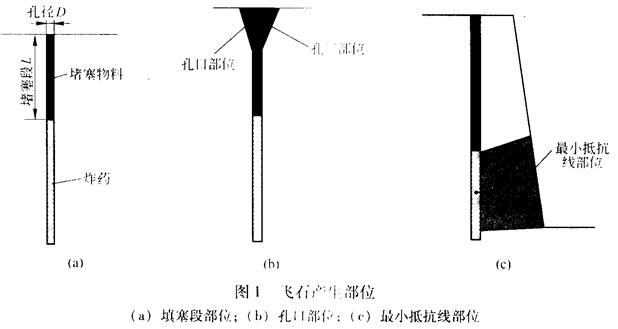
Since the causes of blasting flyrock generation are multifaceted and the situations are quite complex, it is currently difficult to analyze them with a systematic theory. According to experience, the main locations of blasting flyrock generation are the stemming section, the hole mouth and the minimum burden, 3 places, as shown in Figure 1.
3 Parameter Calculation of Blasting Flyrock
The generation mechanism of blasting flyrock is very complex, and it is currently difficult to accurately calculate its parameters with mathematical analysis methods. The flight parameters of individual flyrock are related to factors such as the terrain and geological conditions of the blasting area, blasting parameters, stemming quality and climatic conditions. The flight height and distance of individual flyrock in cast blasting can be calculated by the following formulas [1]:


Where H is the maximum flight height of individual flyrock, m; l is the horizontal flight distance of individual flyrock, m; vo is the initial velocity, m/s; α is the flyrock throwing angle, (°); g is the gravitational acceleration, m/s2.
When blasting on sloped terrain, if the hillside angle is β, the maximum flyrock distance along the downhill side of the slope is:

Where l' is the maximum distance of individual flyrock, m; β is the hillside angle, (°):
In engineering practice, the flight height and distance of flyrock are difficult to determine; therefore, based on a large amount of actual engineering data, people have proposed the following empirical formula:
l=20kn2W (4)
Where l is the farthest flight distance of individual flyrock, m; n is the blasting action index; k is the coefficient related to terrain, wind direction and other factors, generally taken as 1.0 to 1.5; W is the minimum burden, m.
4 Control Methods for Blasting Flyrock
In open-pit blasting, the generation of blasting flyrock is inevitable. However, the generated blasting flyrock must be controlled within the permitted range, otherwise it will pose a threat to people's lives and property. Therefore, during the blasting process, flyrock prevention and protection measures should be taken in a timely manner.
4.1 Measures to reduce flyrock generation
(1) Under conditions meeting the engineering requirements, a relatively reasonable minimum burden should be selected. The selection of the minimum burden is one of the key factors in controlling flyrock generation, and also the most effective technical measure.
(2) When necessary, small-diameter dispersed charging, decoupled charging and reverse initiation can be adopted. A large amount of practice shows that small-diameter blasting produces less flyrock than large-diameter blasting. Reverse initiation can prolong the action time of explosion gases, make rock mass fragmentation more complete, and reduce blasting flyrock.
(3) Adjust the local charging structure [8]. When drilling construction errors make the minimum burden too small, or when drilling encounters faults or weak interlayers, the charging structure should be adjusted, such as adopting spaced charging and reducing the single-hole charge quantity, to avoid flyrock generation.
(4) Ensure the stemming length and quality of blastholes. Blasthole stemming should have a certain length, generally taken as 1 times the minimum burden length. The stemming should be dense and continuous; the stemming material should avoid mixed crushed stones; when stemming, fill and tamp simultaneously; do not fill the blasthole to the hole mouth and then tamp. If there is water in the blasthole, to avoid a blow-out shot, it is best to use 5-10 mm crushed stones or stone powder as the stemming material.
(5) Determine a reasonable initiation sequence and optimal delay time according to geological conditions and hole pattern parameters, to control blasting flyrock within the permitted range.
(6) Accurately calculate and control the explosive quantity. For specific geological conditions, the charge quantity ultimately determines the blasting effect and the degree of control of harmful blasting effects. Therefore, according to the actual site conditions, the explosive unit consumption corresponding to the rock should be selected, and the charge quantity of each blasthole accurately calculated; the charge quantity must not be increased or decreased arbitrarily, especially not increased.
4.2 Covering measures
When the environment around the blasting point is relatively complex, wet straw mats, earth-filled straw bags, rubber belt chains, wire meshes, etc. should be used to cover the blastholes or even the entire blasted object as necessary.
4.3 Reasonably set the warning zone
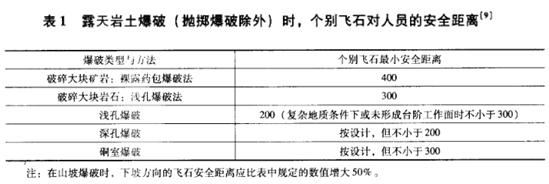
In open-pit rock and soil blasting, the safety distances of individual flyrock to personnel are shown in Table 1. The blasting warning range should be determined with reference to the values in Table 1 in the design. No personnel are allowed within this range, and all unrelated personnel should stay away from the warning line; blasting guards sticking to the warning line at initiation should be in a blast shelter capable of withstanding flyrock impact [10].
5 Conclusion
In open-pit blasting, there are many causes of blasting flyrock, such as design problems, geological conditions, personnel management factors and construction problems; the laws of blasting flyrock also need further research. However, through the analysis of the causes and locations of blasting flyrock generation, blasting flyrock accidents can be reduced to a certain extent. Analyzing flyrock accidents over the years, a large part are human causes. Therefore, on-site management must be strengthened, a sound safety responsibility system established, various rules and regulations and blasting construction essentials strictly implemented, the safety awareness of blasting operators and managers further improved, and complacency overcome; this is an extremely important link in preventing blasting flyrock accidents.
References
[1] Gao Xin, Yang Renshu. Blasting Engineering [M]. Xuzhou: China University of Mining and Technology Press, 1997: 249.
[2] Zhang Chao, Yang Junwei. Cause analysis of flyrock accidents in open-pit mines [J]. Science and Technology Information, 2011(30): 356.
[3] Gao Yushan. Methods to improve blasting quality in open-pit mines [J]. Engineering Blasting, 1999(01): 59-62, 75.
[4] Gao Wenle, Bi Weiguo, et al. Case analysis of flyrock causing death [J]. Blasting, 2002(3): 77-78.
[5] Ren Xiang, Guo Xuebin. Flyrock in engineering blasting and its control [J]. West-China Exploration Engineering, 2005(12): 181-182.
[6] Wang Xinjian. Causes of flyrock generation and control countermeasures [J]. Journal of the People's Public Security University, 1988(1): 84-85.
[7] Ren Xiang, Wei Aiyong. Control and protection of blasting flyrock [J]. Mining Technology, 2005, 5(1): 80-81.
[8] Zhang Zhicheng, et al. Blasting Principles and Design [M]. Chongqing: Chongqing University Press, 1992.
[9] Chen Qingkai, Mei Zhixue, Zhao Dexiao. Engineering Blasting Technology and Safety Management [M]. Shenyang: Northeastern University Press, 2002: 164.
[10] Gao Yushan. Controlled blasting of the deep-hole edge blasting zone in open-pit mines [J]. Benxi Steel Technology, 2000(02): 2-4.
Excerpted from New Progress of Blasting in China
