
 中文
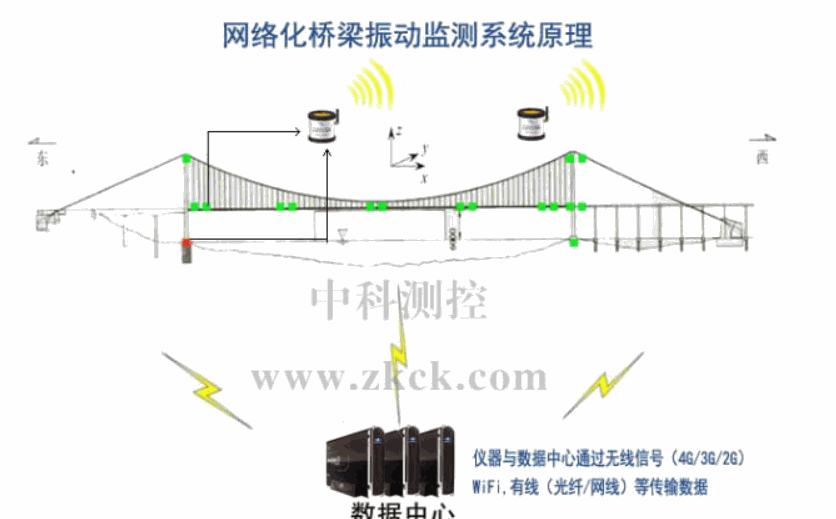
Online bridge vibration monitoring solution
Online bridge vibration monitoring solution In recent years, with more large buildings and high-tech applications, structural health monitoring is moving toward integration, automation, digitalization and intelligence. Bridge vibration monitoring - of vibration frequency and amplitude - is an essential part of bridge health monitoring systems. During construction and service of bridges and large buildings, concrete or

Blasting vibration control research
Based on the Wuhan Nanguo Tanhualin foundation-pit excavation blasting project, this article introduces vibration control measures in complex urban environments, focusing on the effects of charge structure and damping trenches on vibration peaks, with analysis of field monitoring data. Results: two-layer charging gives markedly lower peak vibration than continuous charging - an 18.7% reduction; damping trenches are clearly effective - a 30.5% reduction at the same point. For urban pit blasting, improved
Discussion on blasting vibration monitoring technology - vibration monitor
1. Blasting seismic effects and monitoring Explosions produce shock waves that attenuate into stress waves in rock with decreasing energy; when they can no longer break rock, they only cause elastic particle vibration - seismic waves. Seismic waves carry only 2-6% of total explosion energy. By path: body waves inside rock and surface waves along rock surfaces. Body waves divide into P and S waves; surface waves into Rayleigh and Love waves. Rayleigh waves have low frequency, slow attenuation and large amplitude
Effect of maximum charge per delay on frequency-band energy distribution of blasting vibration signals
Abstract: Based on the short-time non-stationary nature of blasting vibration signals, wavelet packet analysis explores the relation between frequency-band energy distribution and maximum charge per delay for underground blasting. Wavelet transform and wavelet packet features are introduced; deep wavelet packet analysis in MATLAB yields energy distribution maps across frequency bands; finally, rules between energy distribution and maximum charge are analyzed. Keywords: maximum charge per delay; blasting vibration;
Layout selection for blasting vibration meters in monitoring
Layout 1: ordinary ground buildings. 1. Control points on foundations or bottom slabs of main load-bearing outer walls; 2. buildings above 4 floors (12 m): points every 4 floors and at the top; 3. structures over 10 m long: a point roughly every 10 m horizontally; 4. for precision instruments: points on foundations or equipment members; Layout 2: tunnels and roadways. 1. Control points 10-15 m from the blast source; 2. for underground powerhouse excavation, layout
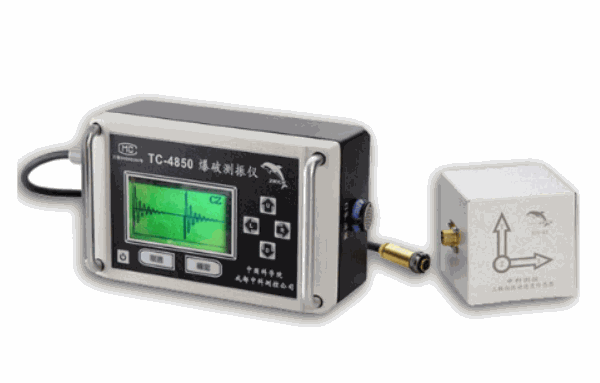
Application of low-frequency and high-sensitivity sensors for blasting vibration meters
Application of low-frequency and high-sensitivity sensors. For the scenarios below, we developed low-frequency and high-sensitivity sensors - thoroughly solving low-band signal loss and higher precision needs. Combined with TC-4850 and TC-4850N meters in various configurations, they meet diverse user needs. 1. For recording engineering blasting: especially deep-hole (10 m+) and chamber blasting, and 1-10 Hz low-frequency vibration from soft soil and underwater blasting. 2. Vibration monitoring and fault
On-site coordination and cooperation for blasting - vibration meter
On-site coordination - responsibilities of the monitoring unit: (1) Submit the monitoring plan for client approval; submit point layout drawings before each monitoring. (2) Appoint an on-site liaison to coordinate cooperation. (3) Start preparation at least 2 h before the blast, finish 30 min ahead, and notify the alert leader. (4) Follow site blasting safety rules to ensure personnel and equipment safety. (5) Clean up the work site promptly after testing. (6) Submit monitoring results in time. Civil contractor cooperation
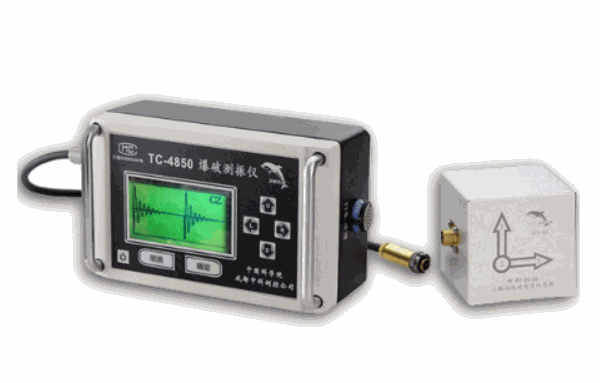
Operation precautions and selection of blasting vibration meters
Operation precautions - sensors: accurate installation is vital for data reliability. On site, note: (1) measurement direction must be accurate - level and orient with a spirit level and compass for correct triaxial orientation; (2) install on structures integral with the monitored object, at the position closest to the blast point; (3) sensors must be reliably bonded - gypsum powder, AB glue, or clamps and
Purpose and contents of blasting monitoring - vibration meter
Main purposes of blasting monitoring: (1) obtain attenuation laws along unfavorable sections or unsafe directions via monitoring and tests; regress propagation formulas to estimate maximum allowable charge and safe distances - supporting construction plans and parameters; (2) evaluate the rationality of plans and parameters for control and optimization; (3) measure vibration impact on vibration-sensitive buildings, rock and soil,
How to record and describe the damage degree of seismic waves?
Blasting vibration meters monitor seismic-wave velocity. Blasting seismic waves are broadband, complex waves propagating both along the surface and spherically; the non-uniform, complex ground makes simple accurate results difficult. Blasting seismic waves are elastic waves - body waves inside the medium and surface waves along the ground. Body waves divide into P and S waves; P waves are compression waves propagating spherically by repeated compression and extension of the medium
