中文
Interpreting Blasting Vibration Data: Why Peak Particle Velocity and Frequency Must Be Evaluated Together
Many monitoring reports cite only the peak particle velocity while ignoring the dominant frequency. This article explains why GB 6722-2014 adopts a combined velocity-frequency safety criterion and describes proper field data acquisition practices.
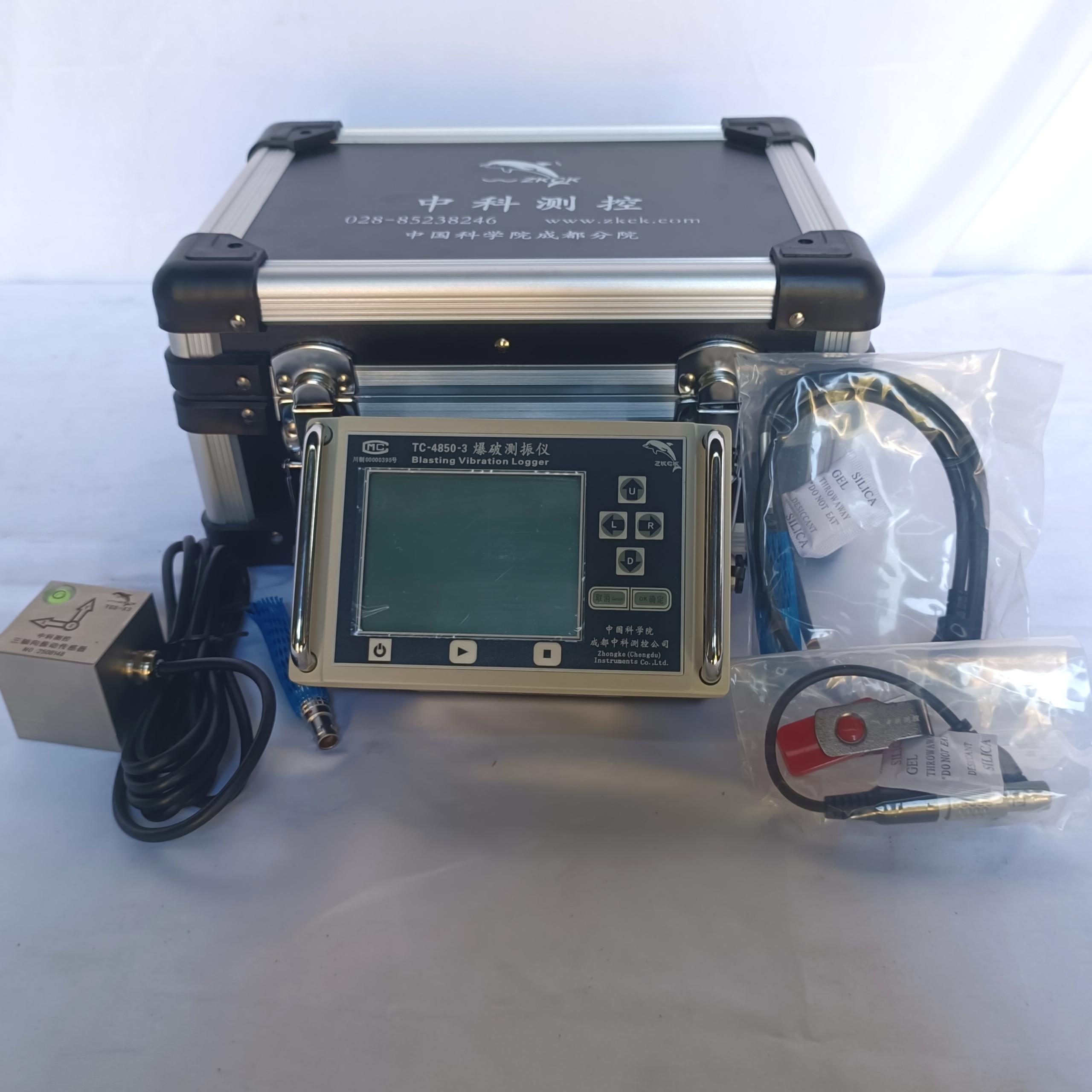
Compliance analysis of TC-4850 series blasting vibration meters with DL/T 5333-2021
1. Introduction. DL/T 5333-2021 is the core standard for blasting vibration monitoring in hydropower, imposing mandatory requirements on instrument parameters, metrological qualification and functions. As mainstream equipment in domestic blasting monitoring, the compliance of ZKCK TC-4850 series is a key concern. This article analyzes the full TC-4850-3/6 and TC-4850N-3/6 range in terms of specifications, functions and certifications

Complete layout guide for tunnel blasting excavation, lining and surrounding-rock vibration monitoring (with official specification text)
In drill-and-blast tunneling, seismic waves spread into surrounding rock and easily disturb formed rock, primary support and secondary lining behind the face. Excessive vibration can crack shotcrete or loosen rock and even induce collapse. Therefore, blasting vibration monitoring of the tunnel body is the core means of quality control, structural risk avoidance and parameter optimization. Based on GB 6722-2014 and T/CSEB 0008-2019

Blasting vibration meter and sensor installation
1 Determine installation methods per terrain at each point and consider point safety; protective measures when necessary. Minimum safe distances for flyrock by blasting type: boulder breaking, bare charge 400 m; boulder breaking, shallow-hole 300 m; shallow-hole 200 m (≥300 m in complex geology or without bench face); shallow-hole springing 300 m; deep-hole per design, ≥300 m; shallow-hole bottom expansion 50 m; deep-hole bottom expansion 50 m; chamber per design, but

Summary of measuring-point selection and layout principles in blasting vibration
When blasting near protected objects, monitoring points should be laid at the nearest point between the object and the blast area Layout shall consider point safety with protective measures when necessary; for critical points, multiple comparison points may be deployed. Points should avoid trenches, sudden terrain changes and artificial modifications, and preferably sit on the same undisturbed soil layer or bedrock.

Online mine-slope vibration monitoring solution
ZKCK online mine-slope vibration monitoring solution - mine and slope online vibration monitoring to safeguard mine slopes

Selection and number of measuring points in blasting vibration monitoring
Point selection often troubles testers. This article summarizes selection and counts by scenario: 01 attenuation law tests (regression): ≥6 points per blast; 02 one-time monitoring: match as needed; 03 long-term monitoring: ≥2 points; 04 foundation pit: 1-2+ points, 1 per km for pits over 1000 m ; 05 hydropower: 3-6+ points; 06 mine: 1-2+ points, over

Protection methods for sensors and acquisition units in blasting vibration monitoring
In field monitoring, single blasts are non-repeatable - if a point is covered by mounds or the instrument hit by flyrock, data is lost. Protection keeps sensors and recorders safe: 1 For near points or critical points prone to large flyrock, use precast reinforced-concrete frames or barriers, adding steel plates on top when necessary; 2 For points expected to suffer only

Several methods to reduce blasting vibration
How to reduce blasting vibration? Considering seismic hazards to structures, amplitude, frequency and duration should all be considered; repeated blasting has damage-accumulation effects and deserves attention. There are many methods to reduce blasting seismic effects